
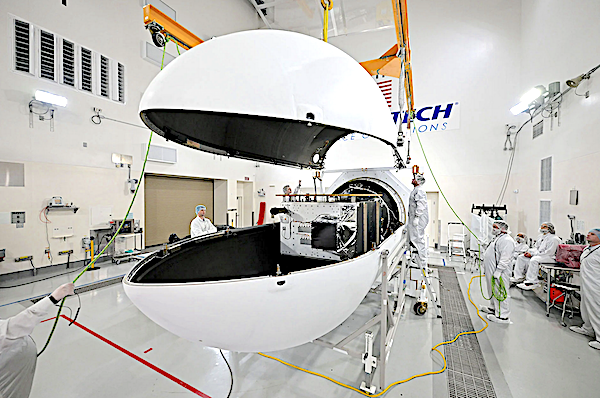
Firefly Aerospace’s launch of Lockheed Martin’s FLTA006 (Message in a Booster) from Space Launch Complex 2W, Vandenberg SFB, California, is yet to be determined.
Alpha FLTA006 is the second mission Firefly is launching for Lockheed Martin and the first of Firefly’s multi-launch agreement with Lockheed Martin that includes up to 25 missions over the next five years. This mission will launch Lockheed Martin’s LM 400 tech demo to prove out the risk-reduction and pathfinding efforts the company has done for its multi-mission satellite bus. Launching the mid-size satellite to low Earth orbit, FLTA006 will further validate Alpha’s robust performance to take customers directly to their preferred orbits as the only operational 1 metric ton rocket.
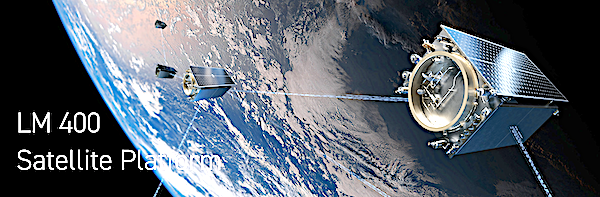
The LM 400 is Lockheed Martin’s most flexible and capable satellite platform with multi-mission capabilities that can be tailored for almost any mission, including remote sensing, communications, imaging and radar.
Firefly Aerospace’s Firefly Alpha to launch Lockheed Martin’s FLTA006 Message in a Booster mission on Friday


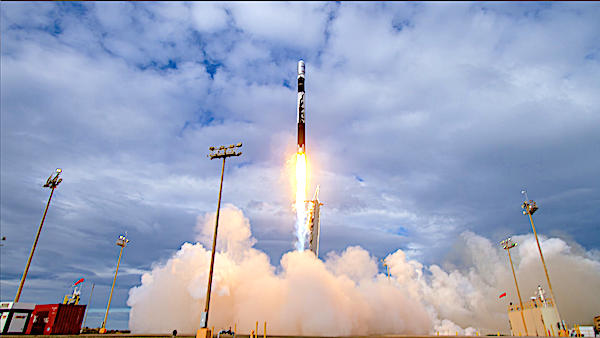
On Friday, April 18 Firefly Aerospace will launch FLTA006 (Message in a Booster) between 6:37 AM – 8:17 AM PDT Space Launch Complex 2W, Vandenberg SFB, California, at a cost of $15Million.
Firefly Aerospace is an American private aerospace firm based in Austin, Texas, that develops small and medium-sized launch vehicles for commercial launches to orbit.
The forecast calls for a temperature of 51°F, clear skies, 0% cloud cover and a wind speed of 14mph.
This launch will be the sixth flight of the Firefly Alpha small satellite launcher, launching the demonstration mission for Lockheed Martin’s new LM400 satellite bus, which will carry a communications payload. The satellite bus is customizable to support different missions, including remote sensing, communications, imagery and radar Earth observations. It can also support different kinds of orbits and launch configurations.
Alpha FLTA006 is the second mission Firefly is launching for Lockheed Martin and the first of Firefly’s multi-launch agreement with Lockheed Martin that includes up to 25 missions over the next five years. This mission will launch Lockheed Martin’s LM 400 tech demo to prove out the risk-reduction and pathfinding efforts the company has done for its multi-mission satellite bus. Launching the mid-size satellite to low Earth orbit, FLTA006 will further validate Alpha’s robust performance to take customers directly to their preferred orbits as the only operational 1 metric ton rocket.
The LM 400 is Lockheed Martin’s most flexible and capable satellite platform with multi-mission capabilities that can be tailored for almost any mission, including remote sensing, communications, imaging and radar.
Approximately the volume of an average home refrigerator and accommodating payloads up to 1,100kg, this mid-sized bus features exceptional propulsion and optimal operability in low Earth orbit (LEO), medium Earth orbit (MEO) and geosynchronous Earth orbit (GEO) compared to others in its class.
The demand for LM 400 plays an important role in the evolving Space industry. Space missions are adopting proliferated network architectures that use a multitude of smaller satellites in differing orbits to form a robust constellation, offering greater resilience in the face of threats or unforeseen anomalies. The LM 400 satellite platform provides a highly flexible bus foundation, resulting in rapid deployment at lower price points to help achieve the connectivity for data transport and missile warning and tracking operations.