

Firefly Aerospace has been awarded a contract to perform a responsive on-orbit mission with the company’s Elytra spacecraft in support of the U.S. Department of Defense’s (DoD) Defense Innovation Unit (DIU) Sinequone Project.
During the DoD mission, Elytra will serve as a space maneuver vehicle to perform a series of responsive on-orbit tasks, including space domain awareness (SDA) operations in LEO—this mission is set to launch as early as 2027.
As part of the mission, Elytra will host a suite of government payloads, including optical visible and infrared cameras, a responsive navigation unit, and a universal electrical bus with a payload interface module. Firefly’s Elytra Dawn configuration will use common components from the company’s launch vehicles and lunar landers, including the avionics, composite structures, and propulsion systems, to enable on-demand mobility, plane changes, and maneuvers with high delta-V capabilities and reliability. Elytra’s main engine, called Spectre, was recently flight-proven on Firefly’s Blue Ghost lunar lander as the reaction control system thrusters that successfully performed Firefly’s final descent on the Moon on March 2.
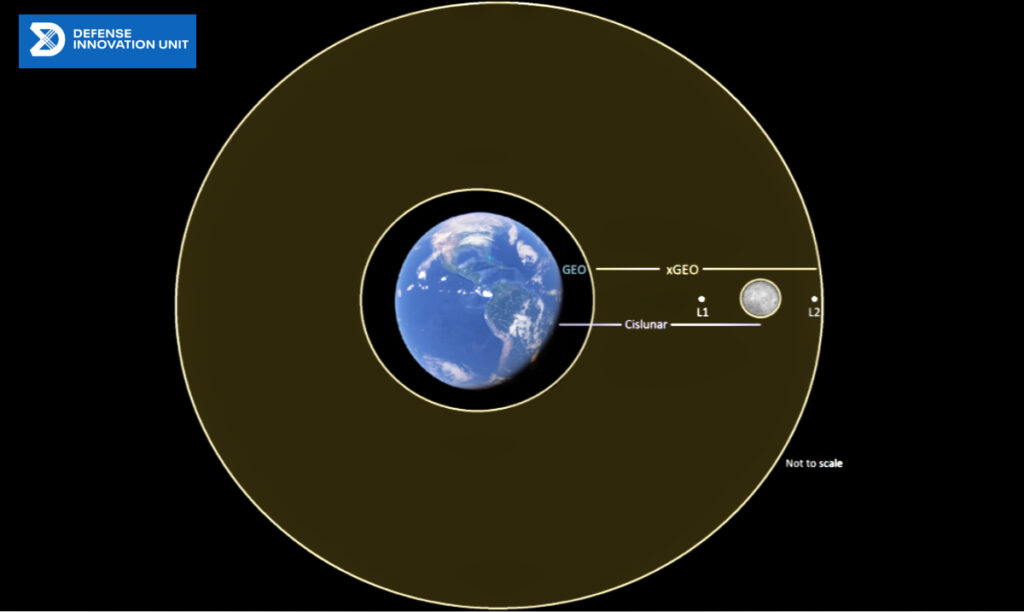
The DoD contract supports the DIU’s Sinequone project that aims to deliver cost-effective, responsive access beyond Geosynchronous orbits, referred to as xGEO. This mission in LEO is the first step to enable future access and operations in xGEO on a responsive timeline. The award follows Firefly’s initial trade studies that were completed for the DIU in 2024.
As demand for responsive on-orbit services continues to grow, Firefly is expanding its spacecraft production capabilities and was recently awarded an $8.2 million grant from the Texas Space Commission to add additional spacecraft clean room space, test facilities, and infrastructure. This will allow Firefly to mass produce Elytra in higher quantities at a lower cost in support of long-haul communications relays, on-orbit payload hosting, maneuverability, and other responsive services across cislunar space.
Firefly has proven our ability to rapidly and reliably launch, land, and operate in space as we continue to execute bold missions from LEO to lunar orbit and beyond,” said Jason Kim, CEO of Firefly Aerospace. “This national security mission will further demonstrate our ability to perform responsive on-orbit tasks when and where our customers need them with our highly maneuverable Elytra orbital vehicle. To achieve this, we equipped Elytra with many of the same flight-proven systems Firefly utilized to successfully land on the Moon after traveling 2.8 million miles across cislunar space.”
About Firefly Aerospace
Firefly Aerospace is an end-to-end responsive space company with launch, lunar, and on-orbit services. Headquartered in central Texas, Firefly is a portfolio company of AE Industrial Partners (“AEI”) focused on delivering rapid, reliable, and affordable space access for government and commercial customers. Firefly’s small- to medium-lift launch vehicles, lunar landers, and orbital vehicles provide the space industry with a single source for missions from low Earth orbit to the surface of the Moon and beyond.