
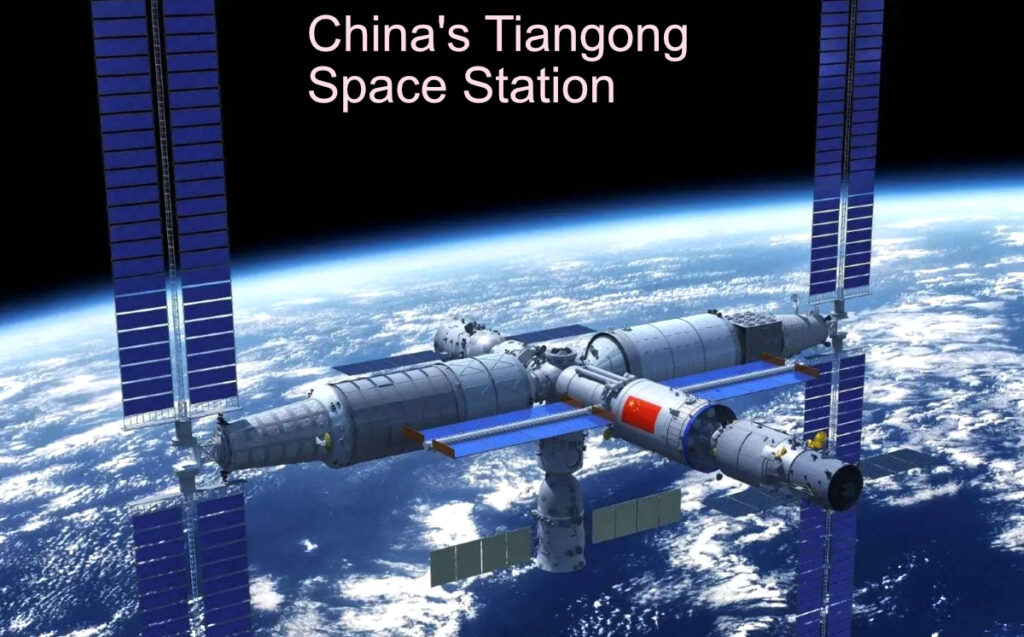

China is poised to welcome Pakistani astronauts to the Tiangong Space Station in an attempt to enhance foreign collaboration and achieve space dominance.
The youngest space station in the world, Tiangong was developed after China was deliberately excluded from the ISS owing to concerns that the Chinese space program was linked to the People’s Liberation Army (PLA). Tiangong was fully assembled in November of 2022 and is currently looking to expand, with the addition of new modules.
China is effectively looking to take over a central role in the future of space exploration and research, with the ISS due to be decommissioned some time around 2030. In addition to rivaling the ISS, China is also looking to use its space dominance as its soft power to forge alliances and expand its influence. This entails participation of foreign space agencies.
In October of 2023, a China Manned Space Agency (CMSA) representative announced that the space station was willing to host astronauts from other countries. “We extend an invitation to the world and welcome all countries and regions committed to the peaceful use of outer space to cooperate with us and participate in the Chinese space station missions,” said Lin Xiqiang, deputy director of CMSA.
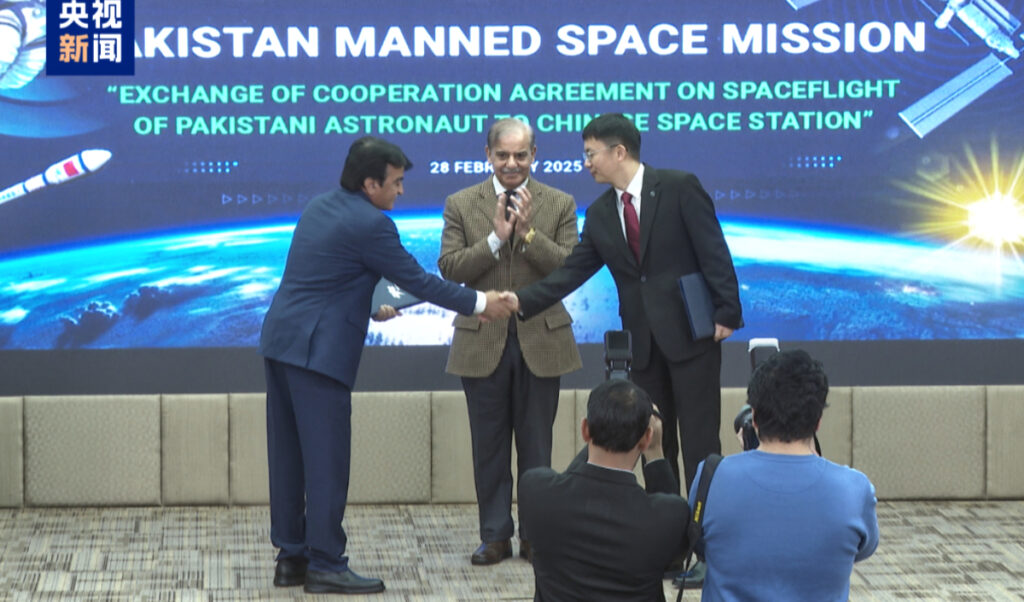
It appears that the first astronauts to visit the youngest space station in the world would be from China’s closest ally, Pakistan. On February 28th, the CMSA signed an agreement with Pakistan Space & Upper Atmosphere Research Commission (SUPARCO) on the selection and training of Pakistani astronauts for upcoming flight missions to China’s Tiangong space station.
The plan calls for both parties to conclude the selection process in around a year, after which the Pakistani candidates will undergo extensive training in China.
The CMSA announced that the Pakistani astronauts will join Chinese taikonauts on short-term flight missions at the Tiangong space station in the coming years. This is the first stage in China’s process of selecting and preparing foreign astronauts to serve on the nation’s space station flight missions.
Chinese experts cited by the state-owned Chinese publication Global Times said the move demonstrates the maturity and reliability of China’s manned space capabilities and represents a significant leap in China’s international collaboration in major space programs.
In what appears to reflect China’s long-term goals of space dominance, Chinese experts pointed out that the country’s goal of reducing the “threshold” for developing nations to access and explore space is also an example of the nation’s fulfillment of its international commitments as a major spacefaring nation.
Kang Guohua, a professor of aerospace engineering at Nanjing University of Aeronautics and Astronautics and a senior member of the Chinese Society of Astronautics, told Global Times that the future international astronauts boarding the Chinese space station might perform payload engineering duties. Thus, astronauts from other nations will be free to conduct their own experiments in Tiangong. “This would allow the world to use China’s space station as a space laboratory,” he said.
The Global Times report specifically mentioned, “China has consistently promoted mechanisms for cooperation among developing countries, such as through South-South Cooperation, the Belt and Road Initiative, and the BRICS mechanism.”
Additionally, it drew a comparison with the ISS, stating that the U.S.-led space station has only welcomed participants from wealthy nations. Thus, once again positioning itself as a “better alternative” to the ISS.
Having said that, the agreement between China and Pakistan comes months after their common adversary, India, announced that Indian astronauts will visit the ISS in a collaborative effort with the U.S. space agency, NASA.
To read the complete The EurAsian Times story, please access this direct infolink…
Article author: Sakshi Tiwari