
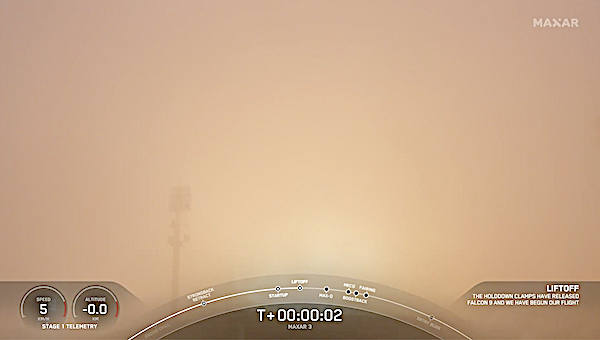
On Tuesday, February 4 at 6:13 p.m. ET, Falcon 9 launched the Maxar 3 mission to orbit from Launch Complex 39A (LC-39A) at Kennedy Space Center in Florida. “The launch of these two satellites will complete the first block of Maxar’s next-generation WorldView Legion satellites,” Maxar representatives said in a prelaunch statement. Photos by Satnews.
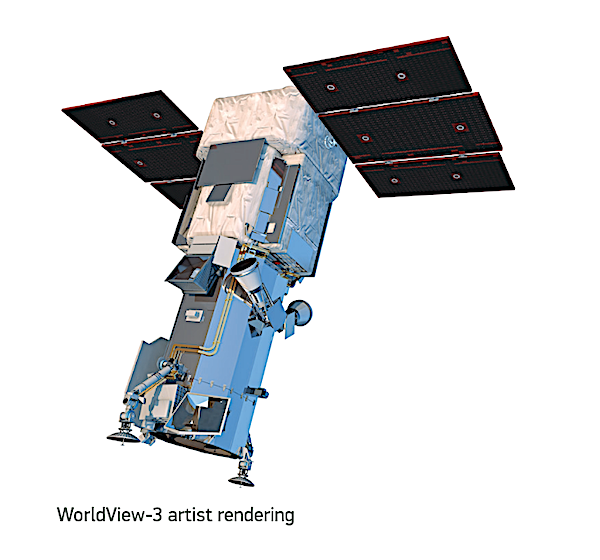
Operating at an altitude of 617 km, WorldView-3 provides 31 cm panchromatic resolution, 1.24 m multispectral resolution, 3.7 m short-wave infrared resolution, and 30 m CAVIS resolution. WorldView-3 has an average revisit time of less than one day and is capable of collecting up to 680,000 sq km per day, further enhancing the Maxar collection capacity for more rapid and reliable collection.
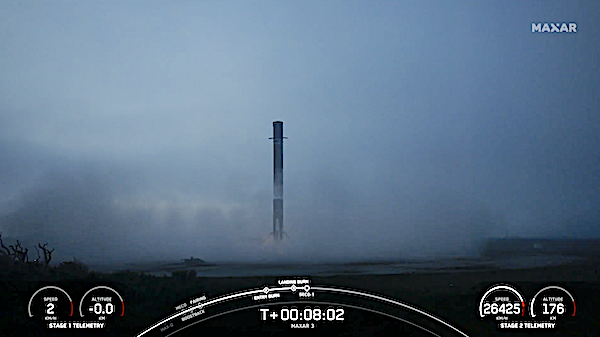
This will be the fourth flight for the Falcon 9 first stage booster supporting this mission, which previously launched GOES-U and two Starlink missions. After stage separation, the first stage will land on Landing Zone 1 (LZ-1) at Cape Canaveral Space Force Station.e Falcon 9 first stage booster supporting this mission, which previously launched GOES-U and two Starlink missions.
SpaceX to launch Maxar 3’s Worldview Legion 5 & 6 Monday
SpaceX is targeting Monday, February 3 for launch of the Maxar 3 mission to orbit from Launch Complex 39A (LC-39A) at Kennedy Space Center in Florida. The 60-minute window opens at 6:32 p.m. ET. If needed, a backup launch opportunity is available on Tuesday, February 4 with a 60-minute window opening at 6:07 p.m. ET.
According to weather officials, there’s a 99% chance of favorable weather conditions at the time of the launch. The forecast calls for a temperature of 67°F, broken clouds, 71% cloud cover and a wind speed of 7mph.
A live webcast of this mission will begin about 15 minutes prior to liftoff, which you can watch here and on X @SpaceX. You can also watch the webcast on the new X TV app.
WorldView-3 is the industry’s first multi-payload, super-spectral, high-resolution commercial satellite. Operating at an altitude of 617 km, WorldView-3 provides 31 cm panchromatic resolution, 1.24 m multispectral resolution, 3.7 m short-wave infrared resolution, and 30 m CAVIS resolution. WorldView-3 has an average revisit time of less than one day and is capable of collecting up to 680,000 sq km per day, further enhancing the Maxar collection capacity for more rapid and reliable collection.
This will be the fourth flight for the Falcon 9 first stage booster supporting this mission, which previously launched GOES-U and two Starlink missions. After stage separation, the first stage will land on Landing Zone 1 (LZ-1) at Cape Canaveral Space Force Station.
SpaceX’s Falcon 9 is scheduled to launch Maxar’s WorldView Legion 5 and 6 on Monday 3:32 to 4:33 PM PST from Launch Complex 39-A at Kennedy Space Center, Florida.
WorldView Legion is a constellation of Earth observation satellites built and operated by Maxar. Constellation is planned to consist of 6 satellites in both polar and mid-inclination orbits, providing 30 cm-class resolution.
Maxar’s history in space technology has guided the creation of the next-generation satellites. From defense and intelligence to living maps for navigation, WorldView Legion satellite imagery will support valuable missions—at unmatched speed, quality and scale.