

Indian Space Research Organization will launch on Tuesday, January 28, at 4:53 PM PST, from Satish Dhawan Space Centre, India.
The forecast calls for a temperature of 78°F, overcast clouds, 100% cloud cover and a wind speed of 10mph.
This is a replacement satellite for the Indian Regional Navigation Satellite System. The constellation will provide India with an alternative to GPS and will be used for military and civilian use. Located at a geosynchronous orbit, the system will be operated by the Indian government.
Indian Research IRNSS-1K (NVS-02) launch Tuesday
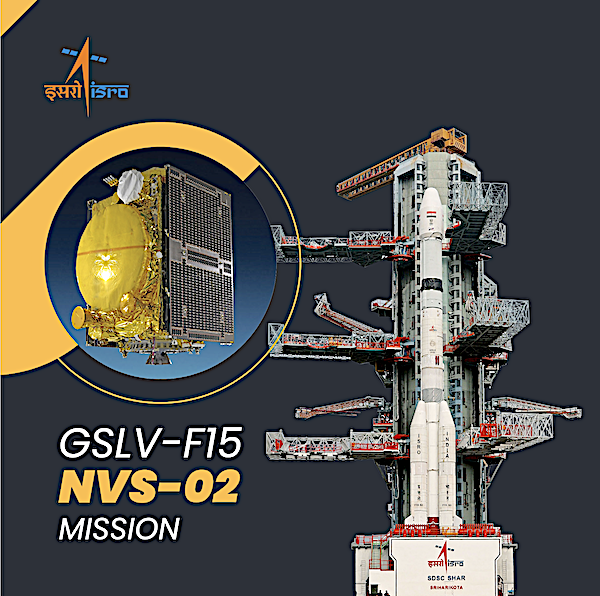
Indian Space Research Organization will launch on Tuesday, January 28, at 4:53 PM PST, from Satish Dhawan Space Centre, India.
This is a replacement satellite for the Indian Regional Navigation Satellite System. The constellation will provide India with an alternative to GPS and will be used for military and civilian use. Located at a geosynchronous orbit, the system will be operated by the Indian government.
GSLV-F15 is the 17th flight of India’s Geosynchronous Satellite Launch Vehicle (GSLV) and 11th flight with Indigenous Cryo stage. It is the eighth operational flight of GSLV with an indigenous Cryogenic stage and 100th launch from the India’s Spaceport Sriharikota.GSLV-F15 payload fairing is a metallic version with a diameter of 3.4 meters.
The GSLV-F15 with indigenous Cryogenic stage will place NVS-02 satellite into a Geosynchronous Transfer Orbit & the launch will take place from the Second Launch Pad (SLP) at Satish Dhawan Space Centre, SHAR.
Navigation with Indian Constellation (NavIC) is India’s independent regional navigation satellite system designed to provide accurate Position, Velocity and Timing (PVT) service to users in India as well as to region extending about 1500 km beyond Indian land mass.
NavIC will provide two types of services, namely, Standard Positioning Service (SPS) and Restricted Service (RS). NavIC’s SPS provides a position accuracy of better than 20 m (2σ) and timing accuracy better than 40 ns (2σ) over the service area.