
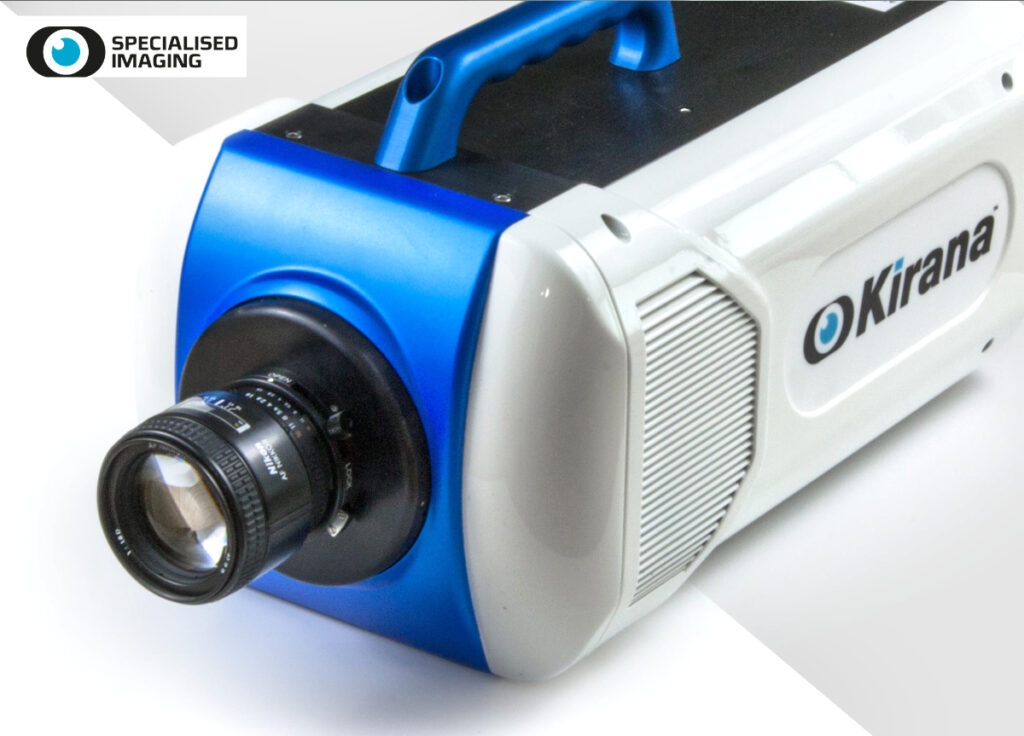
Specialized Imaging reports how U.S. researchers1 used the firm’s Kirana ultra-high speed video camera to investigate the effects of liquid and solid impacts on hypersonic, aerospace bodies.
When an object moves through the atmosphere at hypervelocity, it can get damaged by dust particles or water droplets suspended in that atmosphere. Simply firing dust particles or liquid droplets at samples of material is not always useful in understanding these interactions, so researchers have devised experiments to study the effects of hypersonic bodies moving through the path of droplets thereby simulating weather phenomena.
Since the size and shape of a droplet will impact the amount of damage it does to materials in a high-speed collision, it is important to characterize their exact breakup behavior. The described experimental approach used a Light Gas Gun facility to accelerate various materials to high velocities, introduce water droplets, and study their interactions using advanced diagnostic techniques.
A Kirana ultra-high speed video camera, operating at 5 million frames per second, was used to image the interaction of a projectile at 2.4 km/s velocity with a stream of liquid water droplets in a low-pressure nitrogen medium. Experimental results showed that droplet breakup phenomena including edge-stripping behavior, liquid jetting from the droplet-projectile impact point, and other multiphase hypersonic flow phenomena were present in the experiment.
The Kirana is a true ultra-high-speed video camera that combines the flexibility of a video camera with the speed and resolution approaching those only available with framing cameras. The unique custom design sensor employed by the Kirana offers 180 images at capture speeds up to 7 million images/second at full resolution.
To read the full experimental research article please access this direct PDF link…
1The US research groups who undertook this research were the Stevens Institute of Technology, Hoboken, NJ 07030, USA and the Southwest Research Institute, San Antonio, TX 78238, USA.