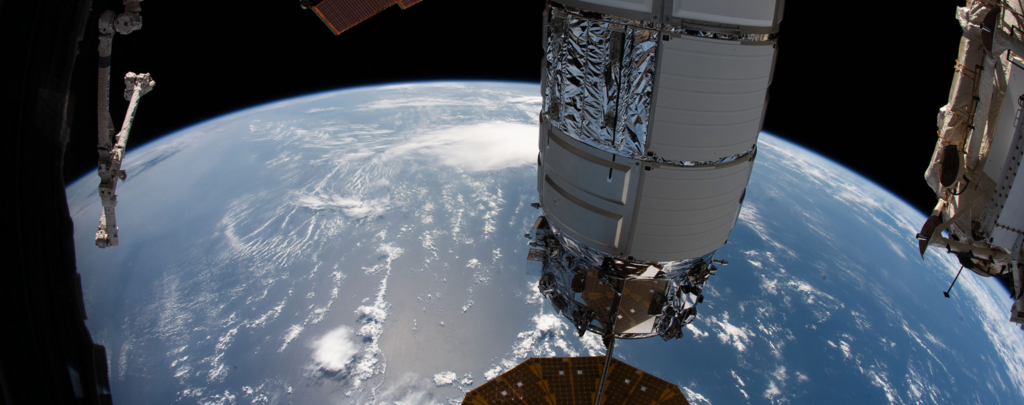
Novel biomedical investigations, technology demonstrations, physical science projects, and much more were launched to the International Space Station (ISS) earlier this month — Northrop Grumman’s 21st Commercial Resupply Services (NG-21) mission to the orbiting laboratory, contracted by NASA, carried more than 900 pounds of critical research and supplies, including more than 20 payloads sponsored by the ISS National Laboratory® — the mission launched from Cape Canaveral Space Force Station on August 4, 2024, at 11:02 a.m. EDT.

Here is a look at some of the ISS National Lab-sponsored investigations that were launched on NG-21 that intend to bring value to humanity and enable commerce in LEO — three of these investigations are also funded by the U.S. National Science Foundation (NSF). They include:
- A project from Florida International University will study the behavior of tiny, engineered particles microscopically dispersed in a liquid to form an active colloid. The team will explore the potential of these particles to extract energy from their surroundings and use it for self-propulsion. Results could inform a variety of applications, from targeted drug delivery to disease screening, water desalination, and photothermal therapies to treat cancer and other diseases.
- An investigation from Northeastern University will study the physics of tiny particles of different sizes dispersed in a fluid that stick together to form a colloidal gel. Understanding the behavior of these particles is important across several industries, including food, medicine, construction, and electronics.
- A project from Notre Dame will examine the physics of bubble formation in microgravity to develop highly sensitive biosensors for detecting trace substances in liquids. The team will use light to generate bubbles that can collect, concentrate, and deposit trace amounts of substances in a solution onto a surface for collection and analysis. This project builds on the team’s prior ISS National Lab-sponsored research, and results could lead to new sensor technology for detecting early cancer markers in blood.
- Two projects are focused on the in-space production of stem cells, which can mature into different types of tissues to improve patient care on Earth. One is an investigation from Cedars-Sinai Medical Center that will test whether human induced pluripotent stem cells (iSPCs) grow and divide faster in microgravity. Results could help establish methods for future large-scale in-space biomanufacturing of stem cell-derived products, which could lead to new treatments for heart disease, neurodegenerative diseases, and many other conditions. For the second project, BioServe aims to develop a novel stem cell expansion bioreactor and protocols for its use in space.
- Sphere Entertainment Co. is in phase two of a technology research experiment testing Big Sky—an ultra-high-resolution, single-sensor camera—on the space station. In the first phase, which launched in November 2022, a commercial off-the-shelf camera collected baseline information while astronauts tested the camera’s use in space. The second phase will see Big Sky—developed by Sphere Entertainment to capture content for Sphere, the next-generation entertainment medium in Las Vegas—tested inside the ISS. Big Sky features the world’s largest image sensor, as well as the world’s sharpest cinematic lenses, and captures detailed, large-format images in a way never before possible. This mission will help validate proper functioning, operations, and video downlink of Big Sky in microgravity conditions to help inform future research.
These are just a few of the investigations that launched on NG-21. To learn about other ISS National Lab-sponsored projects on this mission and view a webinar recording with some of the principal investigators, please visit our launch page.