

On the first day of the Small Satellite Conference in Logan, Utah, Magdrive, a space startup focusing on innovative electrical propulsion systems, and D-Orbit, provider in the space logistics industry, announced a collaboration for Magdrive’s first in-orbit demonstration mission of the Magdrive Rogue propulsion thruster, slated for a June 2025 launch.
“We are very excited to show the industry the potential of our Magdrive system,” says Mark Stokes, CEO of Magdrive. “This mission is the first step to unlocking entirely new capabilities in high cadence avoidance manoeuvres, sustained RPO, and anti-SDA activity for defense in space. We are also extremely grateful to have the support of ESA via their ScaleUp programme for making this mission possible.”
The Magdrive Rogue is a next-generation electrical propulsion system, providing thrust of up to 30 mN with the same high specific impulse as existing electric propulsion systems. Magdrive will be deploying two Rogues onboard D-Orbit’s ION platform to showcase its ability to scale multiple units as an array to serve satellites of any mass class.
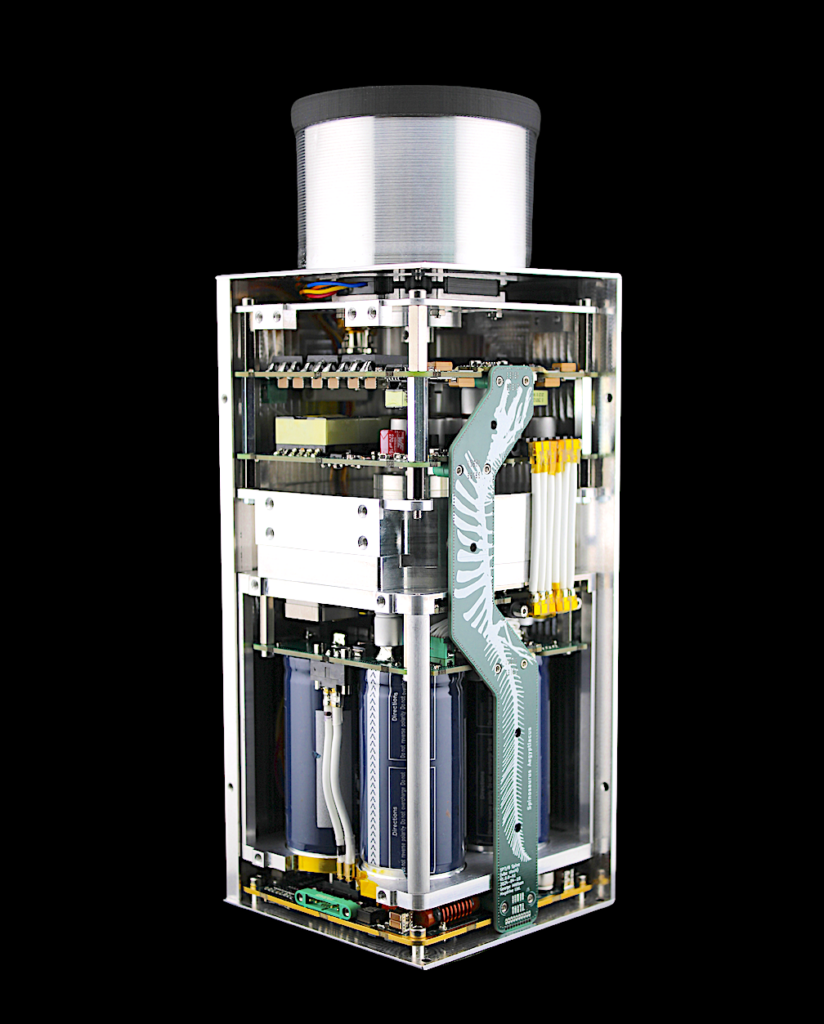
The Magdrive Rogue couples its high thrust with the high efficiencies that electric propulsion systems are known for, creating a game changer for the industry. The fundamental difference is the use of a solid metal propellant instead of a gas (i.e. Hall Effect Thrusters), and the use of internal energy storage to ionize the solid metal into a hot plasma for a higher thrust performance.
Magdrive Rogue will be tested onboard D-Orbit’s proprietary OTV, ION Satellite Carrier. With its proven heritage of 13 successful orbital transportation missions to date, and over 40 hosted payloads already tested in orbit, Magdrive identified ION as the ideal technology to test their electrical propulsion system.
“We are thrilled to collaborate with Magdrive on this mission, leveraging our proven ION platform to demonstrate the potential of the Magdrive Rogue thruster,” said Matteo Lorenzoni, VP of Commercial Strategy at D-Orbit. “We are also excited to support the ESA ScaleUp program through ION; the initiative truly exemplifies ESA’s dedication to fostering advancements and innovations in the space industry and perfectly fits within ION’s scope and capabilities.“
This mission is supported by ESA’s “ScaleUp” program, which enables SMEs to rapidly commercialize their products for the space industry.
“I am pleased to see this deal happen between Magdrive and D-Orbit through ESA’s ScaleUp programme,” said Philip Thomas, Head of ScaleUp Programme Division. “I trust this collaboration will prove fruitful and help both companies achieve even bigger milestones.”
Dr. Thomas Clayson and Mark Stokes founded Magdrive in 2020 to revolutionize in-space travel. Based at the Harwell Science Campus in Oxfordshire they are backed with over £8m in grants from ESA, Innovate UK, UK Space Agency, and the European Innovation Council.
The Magdrive system is a high-power pulsed plasma thruster. It works by storing up energy internally, in order to deliver high-power pulses to detonate a solid metal propellant into a plasma. The technology is scalable, and work has begun on larger and more powerful thruster designs capable of servicing spacecraft classes of 500kg and upwards.