
Chromacity Ltd. has been cited in pioneering research undertaken by Sandia National Laboratories, Albuquerque, USA.
To assess the effectiveness of new semiconductor devices for radiation hardened applications. Sandia used the Chromacity 1280 ultra-fast laser as part of their system to simulate radiation-induced events in logic circuits. High energy particles are known to induce permanent or transitory effects in semiconductor devices. The recent outage in the NASA Voyager 1 spacecraft, where its memory was damaged was likely caused by a high energy particle strike.
Semiconductor devices are becoming more vulnerable to damage caused by high energy particles. Electronics in space have always been vulnerable, with engineers developing an array of countermeasures to mitigate the issues caused by these high energy events. Semiconductor devices are rapidly adopting process technologies with smaller feature sizes, exacerbating the problem, and potentially opening up the possibility of damage in devices used in terrestrial applications.
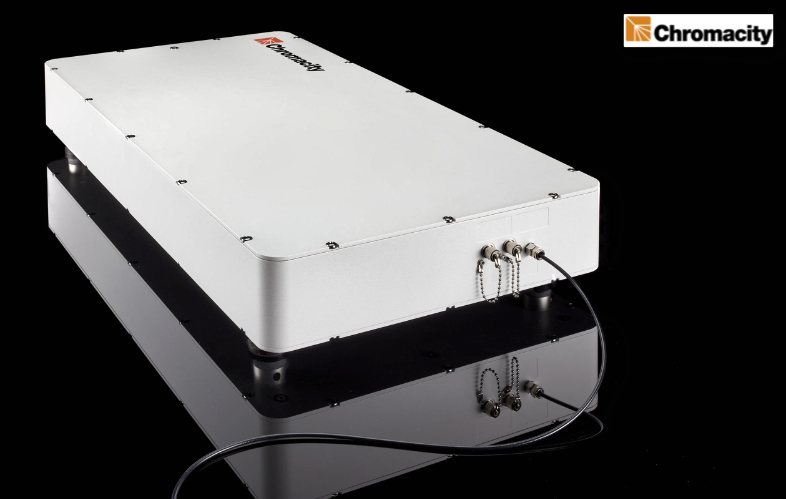
The Chromacity 1280 has a 1280nm central wavelength and can deliver sub 250fs pulses at a 100MHz repetition rate. It is part of a family of fixed wavelength femtosecond lasers, using the company’s patented hybrid free space and fibre architecture, delivering class leading efficiency in a compact and robust form factor.
Chromacity Ltd. is a world leader in the design, development, and manufacturing of advanced ultrafast pulsed fiber lasers. Based in Edinburgh, UK, the company specializes in fixed wavelength femtosecond and picosecond optical parametric oscillator (OPO) based tunable laser systems. Based on a novel patented laser architecture that delivers ultra stable long-term performance, the fixed wavelength femtosecond fiber lasers work at 1040nm and 920nm, and the tunable picosecond OPO lasers work across the near infra-red and mid infra-red wavelengths from 1.4um to 12um. These compact, air-cooled devices offer unrivaled long term pulse stability without the need for on-going maintenance.