

Kepler Communications recently successfully validated optical inter-satellite links (OISLs) between two data relay satellites in LEO.
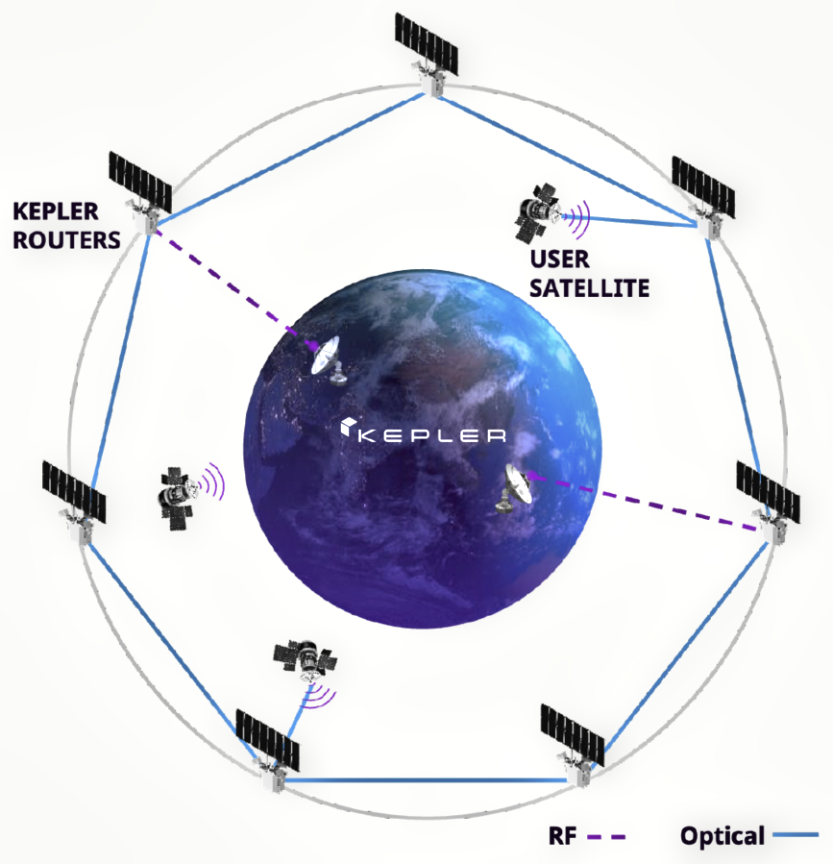
During a commissioning and early operations phase, Kepler established optical inter-satellite links between two Pathfinder satellites equipped with Space Development Agency (SDA) compatible Tesat SCOT80 optical terminals.

The first file transferred over the optical connection was a recent picture of Kepler’s global team gathered near its headquarters in Toronto, Canada (photo below). In the first week of testing, the company successfully sent diagnostic data between the two spacecraft, and the full link performance was demonstrated according to the SDA standard. In addition, multiple acquisition scenarios were tested, and both terminal and spacecraft performed optimally.

In addition to initial optical link commissioning, the company has demonstrated Internet Protocol (IP) mesh networking on-orbit by communicating with multiple satellites in real time over a single ground link, using standard protocols including Secure Shell (SSH), Transmission Control Protocol (TCP), and User Datagram Protocol (UDP).
Kepler is scaling operations to deploy the first Tranche of its next-generation constellation and expects to offer initial optical services in 2025. The hybrid optical data relay network builds on flight heritage from Kepler’s existing constellation of 21 RF satellites. The Kepler Network provides customers with always-available coverage in LEO, streamlining on-orbit communications with sub-second end-to-end latency, gigabit throughputs, and onboard processing to enable access to space-generated data in near-real time.
Established in 2015, Kepler has quickly grown into a global space company and provides secure optical data relay services to government and commercial missions as a partner in modern space communications. The company’s investors include IA Ventures, Costanoa Ventures, Canaan Partners, Tribe Capital, BDC Capital’s Industrial Innovation Venture Fund, and other leading investors. The Canadian Space Agency (CSA) also contributed a grant toward the completion of the Pathfinder technology.
“Kepler is proud to make significant progress in creating the critical Internet infrastructure needed to solve compounding data needs in space. This OISL achievement is a testament to the hard work, determination, and brilliance of our Kepler team,” said Mina Mitry, chief executive officer and co-founder of Kepler. “The Kepler Network will act as a data transport layer, bringing modern Internet capabilities to space through an interoperable architecture that will revolutionize space communications as we know it.”
Kepler Communications, Inc. is a satellite telecommunications provider on a mission to build the Internet for space. Incorporated in 2015, Kepler provides real-time, continuous connectivity for space communications, abolishing barriers to make space-generated data universally available. The company is vertically integrated, with an in-house production facility allowing satellites to be designed and built on-site. The Kepler Network will initially service low Earth orbit (LEO) and plans to provide connectivity services to space missions in LEO, MEO, GEO, and beyond. Headquartered in Toronto, Canada, Kepler is building a global company to enable communications for the future space economy.