
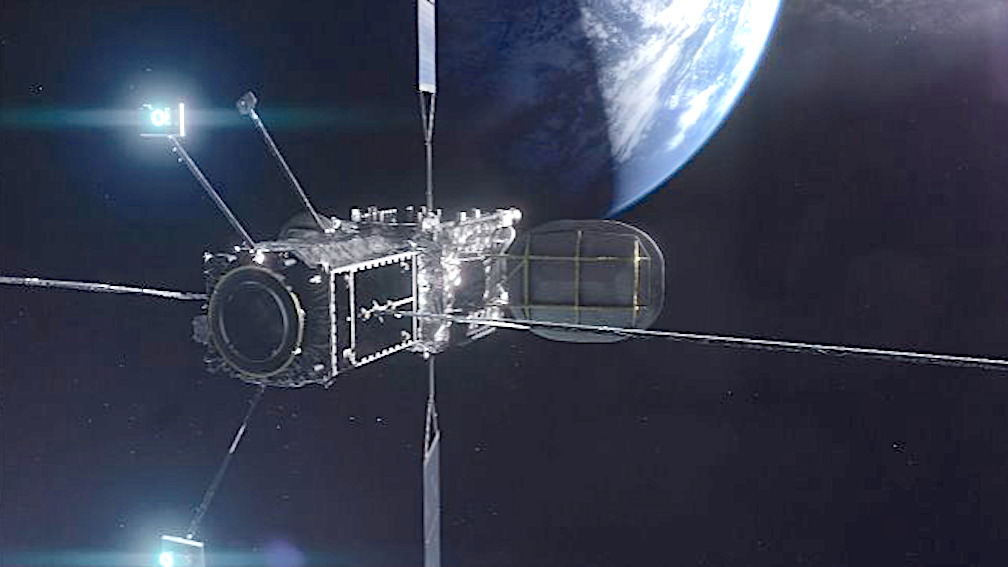
Intelsat, operator of integrated satellite and terrestrial networks and provider of inflight connectivity (IFC), will deliver years of additional reliable broadband, video distribution and mobile satellite service to customers across three continents. This is the result of Northrop Grumman’s innovative Mission Extension Vehicle (MEV) that will ultimately provide an expected additional nine years of life to the Intelsat 10-02 (IS-10-02) geosynchronous satellite.
Geosynchronous Earth orbit (GEO) satellites have an average lifespan of about 15-20 years before they start running low on fuel. Intelsat in 2020 became the first satellite operator to commit to deploying two of Northrop Grumman’s MEVs to extend the life of an otherwise healthy satellite. Both MEVs have been successful at their mission and have allowed IS-10-02 and Intelsat 901 (IS-901) to provide five years of service beyond the expected lifespan of the satellite. Under amendments to the original agreements with Northrop Grumman’s SpaceLogistics LLC, both MEVs will stay in space serving Intelsat satellites for several more years, allowing them to operate longer.
- At the end of the current servicing period, MEV-1 will release the IS-901 satellite into the GEO graveyard and then provide service for another Intelsat satellite.
- MEV-2 will remain docked to Intelsat’s current vehicle, IS-10-02, providing life-extension for several years — nearly doubling service from the original contract. The IS-10-02 satellite was manufactured by Airbus Defense & Space, was launched in June 2004 and entered service in August 2004.
- Capacity on the satellite is shared with Telenor Satellite. Today, MEV-2 is helping to extend the life of IS-10-02, enabling the satellite to continue providing high-quality media distribution and broadband services to customers across Europe, the Middle East, Africa and South America.
- IS-10-02 is a key satellite in the Intelsat-Telenor Satellite video neighborhood, distributing more than 900 channels to nearly 18 million television households across Europe.
“As the largest satellite operator in geosynchronous orbit, Intelsat has always been committed to continuous reliable service, as well as leadership in furthering sustainable space operations,” Jean-Luc Froeliger, SVP Space Systems at Intelsat. “Intelsat continues to pursue first-of-their-kind innovations to extend the life of its satellites in orbit, while also bringing the industry together to foster information sharing and collaboration across a challenging regulatory environment to achieve sustainable stewardship of the resource of space.”
“This extension is excellent news for our many clients across Europe and the Middle East who are served by THOR 10-02,” Morten Tengs, CEO of Telenor Satellite. “We pride ourselves on the resilience of our service and, by extending the life of the satellite, we can ensure continuity and hassle-free operations for a number of years.”
In 2020, MEV-1 successfully docked with the IS-901 satellite, a high-performing satellite that was running low on fuel. That marked the first time that two commercial spacecraft docked and began mission-extension service in GEO. The in-space maneuver pointed IS-901 to targeted antennas on Earth and extended its life for another five years of its lifespan.
In 2021, the feat was repeated with a second MEV-2 docking with the IS-10-02 satellite. Unlike the first docking, which was performed in a graveyard orbit a few hundred kilometers above active satellites, this time the MEV-2 docked with IS-10-02 in its original orbital slot and avoided any interruption of services to customers, resulting in the first-ever in-orbit servicing of a live commercial satellite in GEO.