
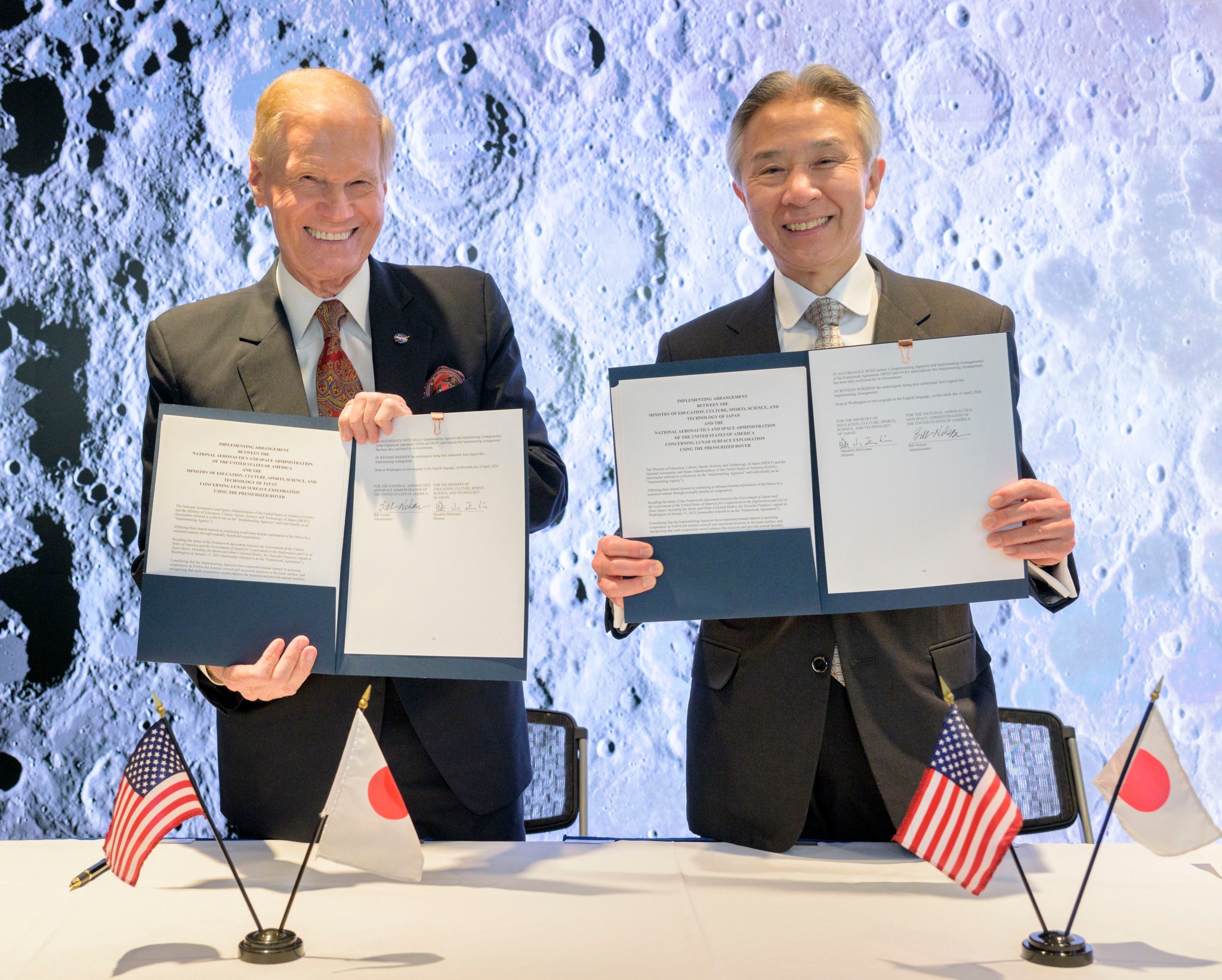
NASA Administrator Bill Nelson (left) and Japan’s Minister of Education, Culture, Sports, Science and Technology (MEXT), Masahito Moriyama (right), have signed an agreement to advance sustainable human exploration of the Moon.

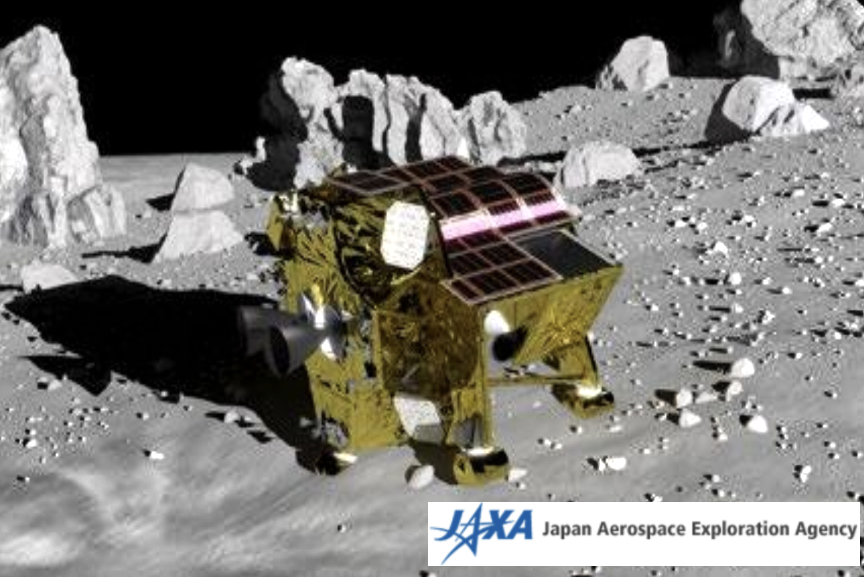
Japan will design, develop, and operate a pressurized rover for crewed and uncrewed exploration on the Moon. NASA will provide the launch and delivery of the rover to the Moon as well as two opportunities for Japanese astronauts to travel to the lunar surface.
The pressurized lunar rover is intended to enable astronauts to travel farther and work for longer periods on the lunar surface. The signing took place at NASA Headquarters in Washington. Along with Nelson and Moriyama, JAXA (Japan Aerospace Exploration Agency) President Hiroshi Yamakawa also participated in the signing.
“The quest for the stars is led by nations that explore the cosmos openly, in peace, and together. This is true for the United States and Japan under the leadership of President Biden and Prime Minister Kishida,” said Nelson. “America no longer will walk on the Moon alone. With this new rover, we will uncover groundbreaking discoveries on the lunar surface that will benefit humanity and inspire the Artemis Generation.”
An enclosed and pressurized rover will enable astronauts to travel farther and conduct science in geographically diverse areas by serving as a mobile habitat and laboratory for the astronauts to live and work for extended periods of time. It will be able to accommodate two astronauts for up to 30 days as they traverse the area near the lunar South Pole. NASA currently plans to use the pressurized rover on Artemis VII and subsequent missions over an approximate 10-year lifespan.
“It was an honor to sign the historic implementing arrangement that will be long remembered as the symbol of the new era of Japan-U.S. partnership for the lunar exploration,” said Moriyama. “Under the partnership stronger than ever, we will drive the initiative together with JAXA, including the development of the pressurized rover that vastly extends the exploration capability on the lunar surface, to realize the shared goal for Japanese and American astronauts to, together, explore the moon.”
The arrangement falls under the “Framework Agreement Between the Government of Japan and the Government of the United States of America for Cooperation in Space Exploration and Use of Outer Space, Including the Moon and Other Celestial Bodies, For Peaceful Purposes,” which was signed in January of 2023 and recognizes the nations’ mutual interest in peaceful exploration.
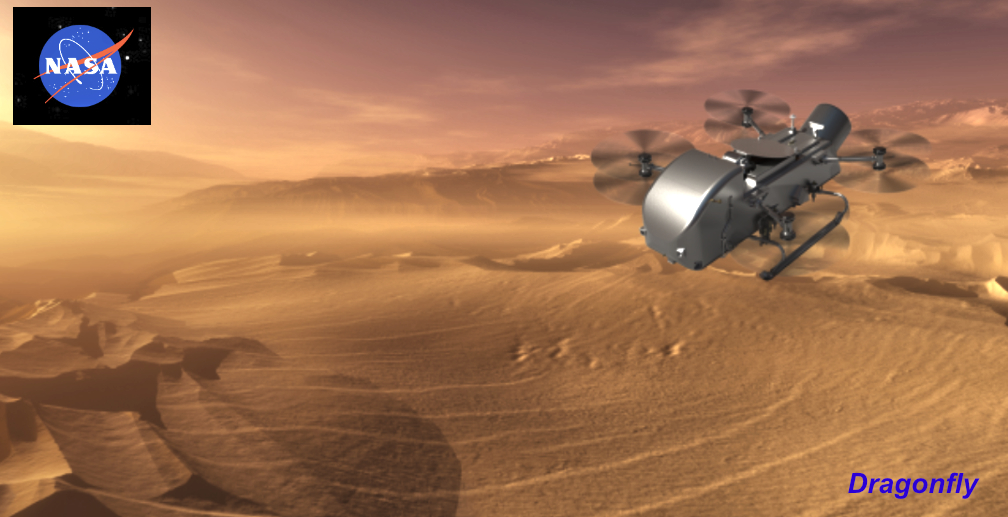
The framework agreement facilitates a broad swath of joint activities between the countries, including space science, Earth science, space operations and exploration, aeronautical science and technology, space technology, space transportation, safety, and mission assurance, and much more. In addition to the agreement for lunar surface exploration, the partners will build on the framework agreement with future agreements for Japan’s participation in NASA’s Dragonfly mission and the Nancy Grace Roman Space Telescope. The U.S. and Japan also intend to collaborate on JAXA’s Next-generation Solar-observing Satellite, SOLAR-C, which will investigate the mysteries of solar atmospheres by conducting observations of ultraviolet radiation from the Sun.

“The pressurized rover will be a powerful contribution to the overall Artemis architecture as Japan and the U.S. go hand in hand with international and industry partners to the lunar surface and beyond,” said Yamakawa. “JAXA is ready to assist MEXT and push this forward with our science and technological expertise to establish sustainable human presence on the Moon.”
Under the Gateway Implementing Arrangement signed in 2022, NASA will also provide an opportunity for a Japanese astronaut to serve as a Gateway crew member on a future Artemis mission and Japan will provide Gateway’s environmental control and life support systems and cargo transportation.
Article author: Abbey A. Donaldson, NASA