
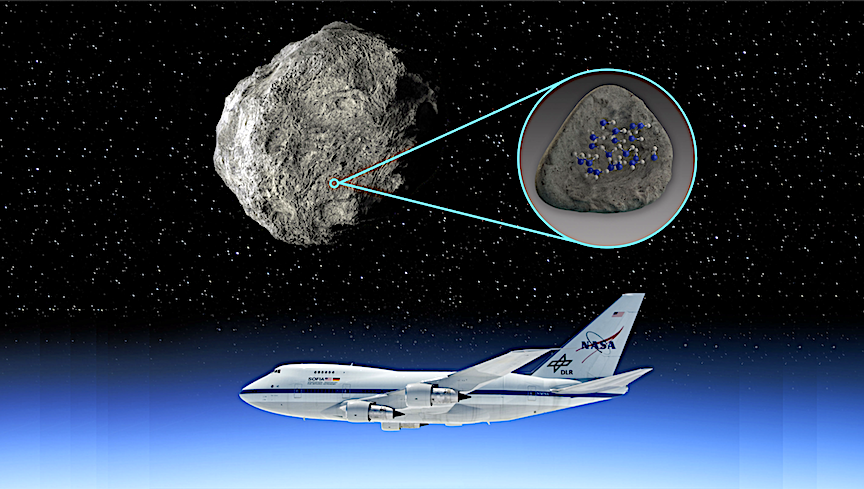
Using data from the retired Stratospheric Observatory for Infrared Astronomy (SOFIA) — a joint project of NASA and the German Space Agency at DLR — Southwest Research Institute scientists have discovered, for the first time, water molecules on the surface of an asteroid. Scientists looked at four silicate-rich asteroids using the FORCAST instrument to isolate the mid-infrared spectral signatures indicative of molecular water on two of them.
“Asteroids are leftovers from the planetary formation process, so their compositions vary depending on where they formed in the solar nebula,” said SwRI’s Dr. Anicia Arredondo, lead author of a Planetary Science Journal paper about the discovery. “Of particular interest is the distribution of water on asteroids, because that can shed light on how water was delivered to Earth.”
Anhydrous, or dry, silicate asteroids form close to the Sun while icy materials coalesce farther out. Understanding the location of asteroids and their compositions tells us how materials in the solar nebula were distributed and have evolved since formation. The distribution of water in our solar system will provide insight into the distribution of water in other solar systems and, because water is necessary for all life on Earth, will drive where to look for potential life, both in our solar system and beyond.
“We detected a feature that is unambiguously attributed to molecular water on the asteroids Iris and Massalia,” Arredondo said. “We based our research on the success of the team that found molecular water on the sunlit surface of the Moon. We thought we could use SOFIA to find this spectral signature on other bodies.”
SOFIA detected water molecules in one of the largest craters in the Moon’s southern hemisphere. Previous observations of both the Moon and asteroids had detected some form of hydrogen but could not distinguish between water and its close chemical relative, hydroxyl. Scientists detected roughly equivalent to a 12-ounce bottle of water trapped in a cubic meter of soil spread across the lunar surface, chemically bound in minerals.
“Based on the band strength of the spectral features, the abundance of water on the asteroid is consistent with that of the sunlit Moon,” Arredondo said. “Similarly, on asteroids, water can also be bound to minerals as well as adsorbed to silicate and trapped or dissolved in silicate impact glass.”
The data from two fainter asteroids, Parthenope and Melpomene, were too noisy to draw a definitive conclusion. The FORCAST instrument is apparently not sensitive enough to detect the water spectral feature if present. However, with these findings, the team is enlisting NASA’s James Webb Space Telescope, the premier infrared space telescope, to use its precise optics and superior signal-to-noise ratio to investigate more targets.
“We have conducted initial measurements for another two asteroids with Webb during cycle two,” Arredondo said. “We have another proposal in for the next cycle to look at another 30 targets. These studies will increase our understanding of the distribution of water in the solar system.”
To access the “Detection of molecular H2O on nominally anhydrous asteroids” paper (open access) , see DOI: 10.3847/PSJ/ad18b8
For more information, visit Planetary Science or contact Deb Schmid, +1 210 522 2254, Communications Department, Southwest Research Institute, 6220 Culebra Road, San Antonio, TX 78238-5166.
Astrobiology, Astrochemistry,
By Keith Cowing of Astrobiology