
UPDATE: NASA and SpaceX are standing down from the October 12 launch of the agency’s Psyche mission due to unfavorable weather conditions. NASA and SpaceX are now targeting launch at 10:19 a.m. EDT Friday, October 13, from Launch Complex 39A at Kennedy Space Center in Florida.
The live launch broadcast with commentary will begin at 9:30 a.m. EDT on the NASA Television public channel and also will air on YouTube, X, Facebook, Twitch, Daily Motion, the NASA app, and the agency’s website.
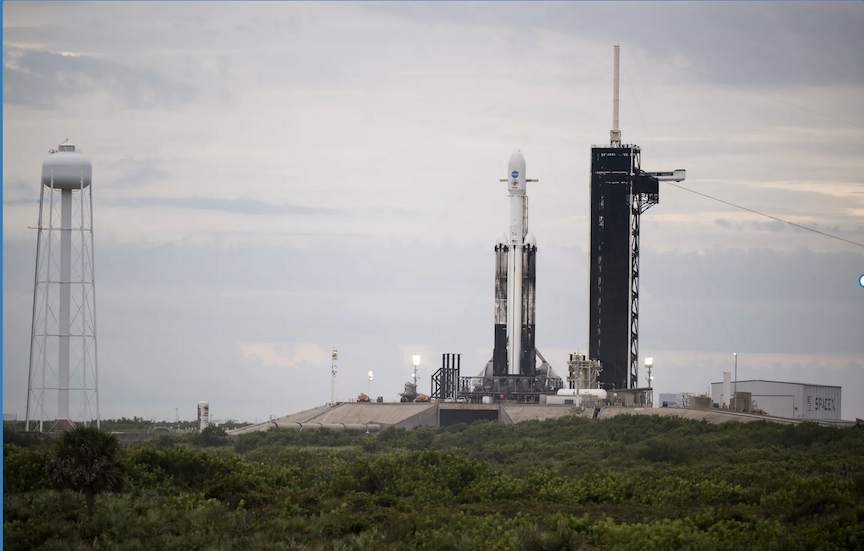
A SpaceX Falcon Heavy rocket with the Psyche spacecraft onboard is seen at Launch Complex 39A as preparations continue for the Psyche mission, Wednesday, Oct. 11, 2023, at NASA’s Kennedy Space Center in Florida. NASA’s Psyche spacecraft will travel to a metal-rich asteroid by the same name orbiting the Sun between Mars and Jupiter to study its composition. The oberpacecraft also carries the agency’s Deep Space Optical Communications technology demonstration, which will test laser communications beyond the Moon.
The spacecraft is targeting an October 12 liftoff atop a Falcon Heavy rocket. Its destination, a metal-rich asteroid, may tell us more about how planets form.
In less than 24 hours, NASA’s Psyche spacecraft is slated to launch from the agency’s Kennedy Space Center in Florida. With its sights set on a mysterious asteroid of the same name, Psyche is NASA’s first scientific mission to be launched on a SpaceX Falcon Heavy rocket.
Launch is set for 10:16 a.m. EDT on Thursday, October 12, with additional opportunities identified each day through October 25. Each opportunity is instantaneous, meaning there is only one exact time per day when launch can occur.
“The team has worked tirelessly to prepare the spacecraft for its journey to a one-of-a-kind asteroid,” said Henry Stone, Psyche’s project manager at NASA’s Jet Propulsion Laboratory in Southern California. “All spacecraft systems, science instruments, and software have been integrated and extensively tested, and the spacecraft is fully configured for flight. We look forward to the launch and – more importantly – to accomplishing the mission’s objectives, marking yet another historic voyage of scientific discovery.“
The orbiter’s solar arrays are folded and stowed for launch. All systems have been tested and re-tested many times, along with the payload of three science instruments. Loaded with 2,392 pounds (1,085 kilograms) of the neutral gas xenon – the propellant that will get Psyche to the asteroid belt – the spacecraft sits inside the launch vehicle’s cone-shaped payload fairing, which protects it from aerodynamic pressure and heat during launch. The spacecraft and fairing have been mated to the SpaceX Falcon Heavy, which is poised for takeoff from Kennedy Space Center’s historic Launch Complex 39A.
Integrated onto the spacecraft is a technology demonstration called Deep Space Optical Communications (DSOC). DSOC will test high-data-rate laser communications – which could be used by future NASA missions – beyond the Moon for the first time. The tech demo will not relay Psyche mission data.
The rocket has two stages and two side boosters. After the side boosters separate and return to land, the core stage will be expended into the Atlantic Ocean. Then the second stage of the rocket, which will help Psyche escape Earth’s gravity, will fire its engine.
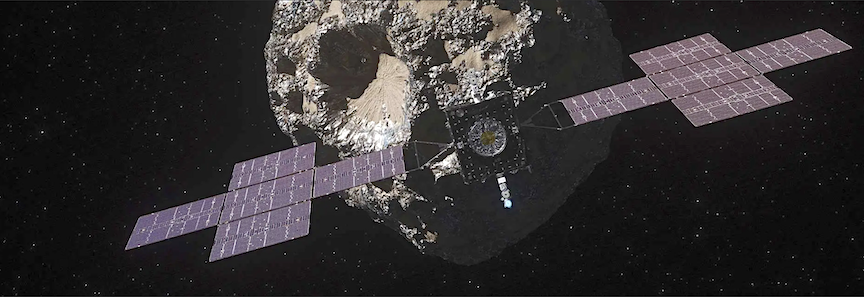
Once the rocket is out of Earth’s atmosphere, about four minutes after launch, the fairing will separate from its ride and split into two halves, which are jettisoned back to Earth. The spacecraft will then separate from the upper stage about an hour after launch. Soon after, it will deploy its twin solar arrays, one at a time, and direct them at the Sun. At this point, the spacecraft is in a planned “safe mode” (a precautionary standby status), with the Sun illuminating the deployed solar panels, and will begin to direct the low-gain antenna toward Earth for communications.
It could take up to two hours after separation from the rocket before the first signal is received.
Once stable communications have been established, mission controllers will begin to reconfigure the spacecraft into its planned operating mode. The ensuing three months of initial checkout include a commissioning phase to confirm that all hardware and software is operating as expected, including the electric thrusters. Starting about five months after launch, the thrusters will fire, one at a time, during long stretches of the trajectory to get to the asteroid.
Psyche’s efficient solar electric propulsion system works by accelerating and expelling charged atoms, or ions, of the neutral gas xenon – creating a thrust that will gently push the spacecraft on a journey of nearly six years and about 2.2 billion miles (3.6 billion kilometers) to the asteroid Psyche in the main asteroid belt between Mars and Jupiter.
Along the way, in May 2026, the spacecraft will fly by Mars and use the Red Planet’s gravity to slingshot itself toward Psyche, saving propellant while gaining speed and changing direction.
After the spacecraft reaches the asteroid in 2029, it will spend about 26 months in orbit, gathering images and other data.
Scientists believe Psyche could be part of the core of a planetesimal – an early planetary building block – and composed of a mixture of rock and iron-nickel metal. The metal will not be mined; it will be studied to give researchers a better idea of what makes up Earth’s core and how rocky planets formed in our solar system. Humans can’t bore a path to our planet’s core – or the cores of the other rocky planets – so visiting Psyche could provide a one-of-a-kind window into the violent history of collisions and accumulation of matter that created planets like our own.
Arizona State University leads the Psyche mission. A division of Caltech in Pasadena, JPL is responsible for the mission’s overall management, system engineering, integration and test, and mission operations. Maxar Technologies in Palo Alto, California, provided the high-power solar electric propulsion spacecraft chassis.More About the Mission
JPL manages DSOC for the Technology Demonstration Missions program within NASA’s Space Technology Mission Directorate and the Space Communications and Navigation program within the Space Operations Mission Directorate.