
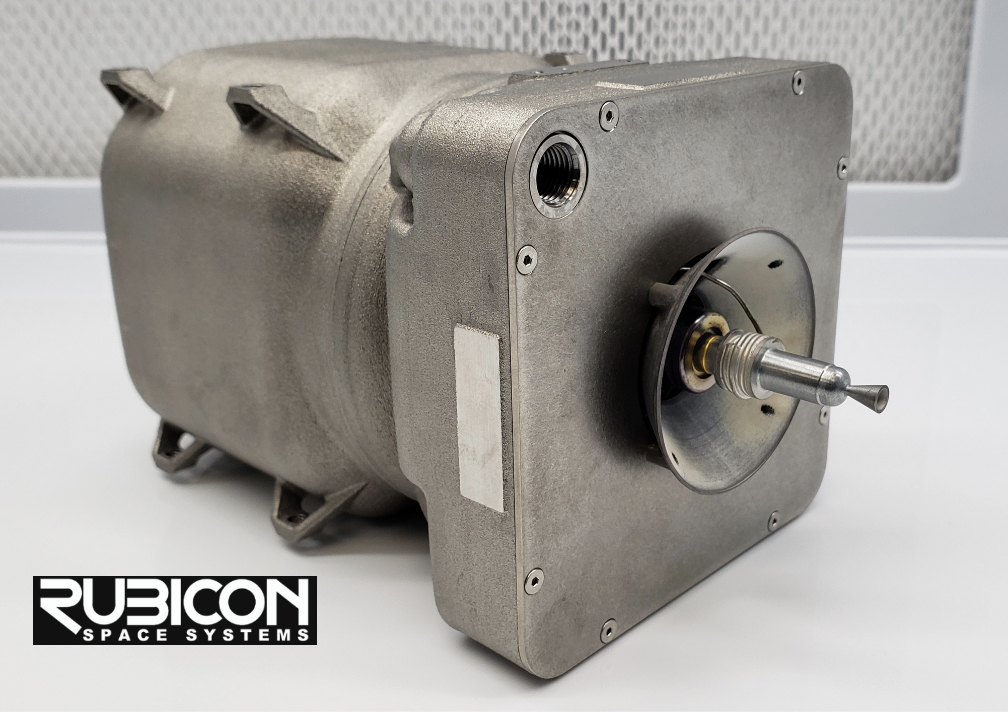
Late last month, Rubicon Space Systems received a NASA contract to deliver ASCENT propulsion systems for use in a technology development effort to advance dual-mode propulsion.
Dual-mode propulsion (sometimes called multi-mode propulsion) is when both chemical and electric thrusters operate using the same propellant. The Sprite propulsion module uses the Advanced Spacecraft Energetic Non-Toxic Propellant (ASCENT) propellant. ASCENT monopropellant based propulsion provides missions with a high performance and low toxicity alternative to hydrazine. As ASCENT is an ionic liquid, it can be used in electric thrusters, as well. NASA will use the Sprite module for the chemical propulsion side of the demonstration but will also siphon propellant from it to feed several electric thrusters.
In development since early 2022, Sprite is a fully enclosed, plug-and-play propulsion system for SmallSats, and is also useful for collision avoidance and deorbit maneuvers. Sprite can deliver more than 1200 Ns of total impulse, the equivalent of 100 m/s of delta V to a 12U CubeSat, and features Rubicon’s flight qualified 0.1N thruster, fully integrated flight controller, and valves. Nearly all components have spaceflight heritage. The Sprite propulsion system passed its Critical Design Review (CDR) in December 2022 and its first four engineering development units (EDUs) are expected to complete qualification efforts in Q3 2023.
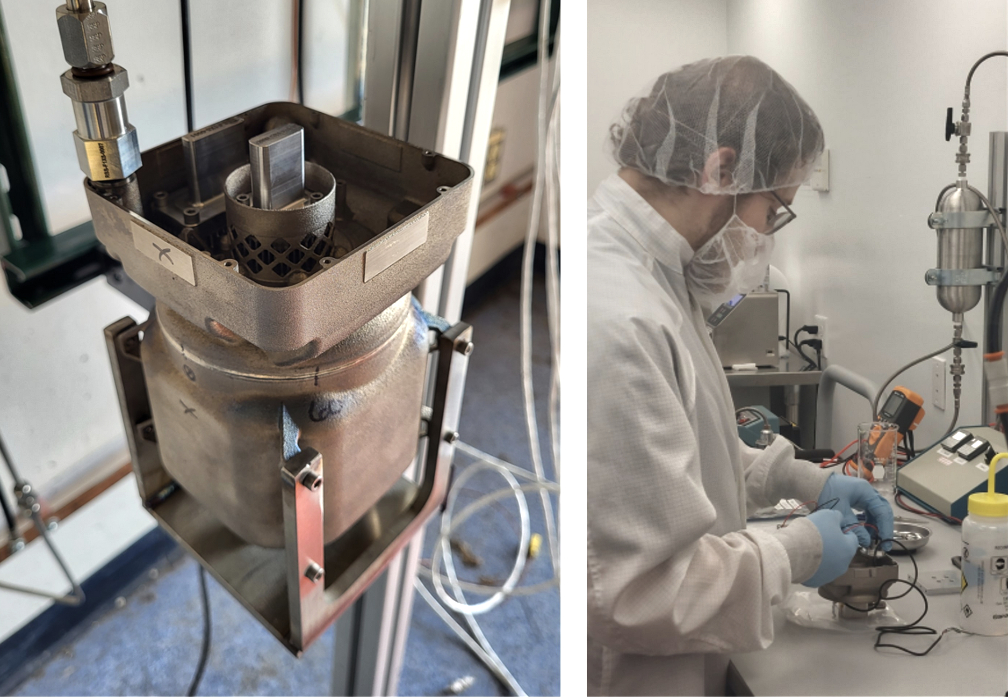
Over the next several months, Rubicon will complete structural qualification of the additively manufactured propellant tank and begin assembly of the protoflight unit.
The award, worth up to $645,000, is made through a Small Business Innovative Research (SBIR) Phase III contract. The NASA technology project is led by NASA Marshall Space Flight Center (MSFC) Science and Technology Office (STO), and is funded by NASA’s Small Spacecraft Technologies (SST) program in the agency’s Space Technology Mission Directorate.
“By March 2024, we will deliver the first flight ready Sprite module to our NASA customer. Dual-mode propulsion is considered the zenith of in-space propulsion. It’s the combination of high impulse and high efficiency in one package. It would allow spacecraft to move with agility and precision. We think this will be commonplace in the near future and the chance for us to be part of this work is terribly exciting for us. We’re glad to be working with NASA to continue innovation and infusion of ASCENT propulsion technologies” — Daniel Cavender, Director of Propulsion, Rubicon Space Systems