
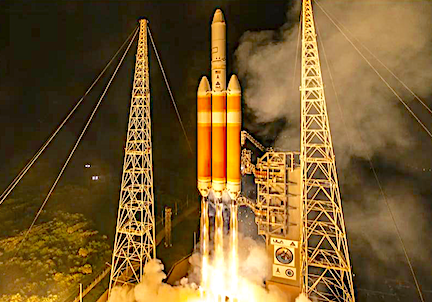
Space Launch Complex-37 at 5:18 a.m. ET, June. 22, 2023. Photo Credit: United Launch Alliance
Space Systems Command (SSC) and its U.S. Space Force mission partners successfully launched a classified payload into Geosynchronous Earth Orbit (GEO) aboard a United Launch Alliance (ULA) Delta IV Heavy rocket for the National Reconnaissance Office today at 5:18 a.m. Eastern (2:18 a.m. Pacific) from Space Launch Complex (SLC)-37B at Cape Canaveral Space Force Station, on the central coast of Florida.

“We had another successful launch for the NRO today. The payload we’ve put into space today adds to the unique capability the NRO provides to keep us safe and out in front of the pacing challenges posed by our Nation’s competitors,” said Maj. Gen. Stephen Purdy, program executive officer for SSC’s Assured Access to Space. “Our national security launches are truly a next-level activity, with pre-launch handling, testing and flight performance requirements that highly require detail-oriented planning and great care. Today’s team, comprised of the NRO, United States Space Force and United Launch Alliance did an immense amount of work behind the scenes to ensure these specialized national assets get to orbit properly and safely.”
There is one Delta IV Heavy remaining to launch for the Space Force, in 2024. By then, the Delta vehicle will have launched the NRO’s heaviest satellites for more than a decade and a half. Following retirement next year, it will be superseded by ULA’s Vulcan, which will lift the next generation of national security and commercial satellites into space with its own innovations.
Upon its retirement in 2024, the Delta IV Heavy lift will have placed over 20+ National Security satellites into operations that have provided our leaders and warfighters vital data used to protect our nation and allies.
The history of the Delta family of launch vehicles date back to the late 1950s with the first launch of a Thor Delta in August of 1960. From there, in response to ever changing mission needs, the Delta evolved from an intermediate range ballistic missile (IRBM) system into an extremely capable and versatile launch platform. This process expanded the Delta’s payload capability from a meager 100 lbs. delivered to an orbit of 115 miles above Earth to a massive 62,550 lbs. (28,370 kg) to low Earth orbit (LEO) or 30,450 lbs. (13,810 kg) to Geostationary Transfer Orbit (GTO).
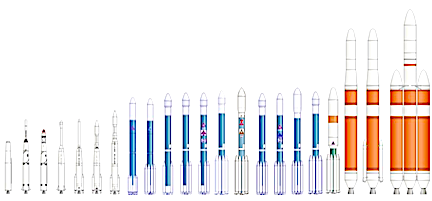
Over the Delta family’s 60+ years of launch heritage, there have been 12 Thor Delta (DM-19) launches, 43 launches of the three-stage A, B, C, D and E configurations, and 27 launches of the two-stage G, J, L, M, and N configurations. Next came the Delta I with 102 launches, followed by the prolific Delta II with the most launches of any Delta configuration at 152. That was followed by the Delta III with three launches. Finally, the Delta IV completed 29 launches of the Medium configuration, from 2002 to 2019 (25 NSSL, three NASA, and one commercial), and 15 launches of the Delta Heavy, including NROL-68.
These various Delta vehicles have launched numerous payloads including military, government, and commercial weather, communications, and science satellites, robotic probes for exploration, eight Mars rovers, and one telescope, all of which have significantly contributed to our understanding of our planet, solar system, and universe beyond. With only one Delta IV Heavy launch planned for 2024, the Space Force nears the end of the long and overwhelmingly successful Delta era.
Assured Access to Space acquires and executes launch services for the USSF, National Reconnaissance Office, and other agencies to reliably deliver on-orbit capabilities to the warfighter. AATS also conducts range operations at Patrick Space Force Base, Florida, and Vandenberg Space Force Base, California, for DoD test missions and for military, intelligence, civil, and commercial launches. AATS is executing transformative range and spaceport initiatives to meet unprecedented launch demands. AATS also leverages industry’s on-orbit servicing, maneuver, and debris removal innovations as it leads USSF Space Access, Mobility and Logistics mission areas. AATS’s 10,000 plus Guardians, Airmen, civilians, and contractor workforce are dedicated to mission success and assured access to space for our nation, partners, and allies.
Space Systems Command is the U.S. Space Force’s field command responsible for acquiring and delivering resilient war fighting capabilities to protect our nation’s strategic advantage in and from space. SSC manages a $15 billion space acquisition budget for the Department of Defense and works in partnership with joint forces, industry, government agencies, academic and allied organizations to accelerate innovation and outpace emerging threats. Our actions today are making the world a better space for tomorrow.