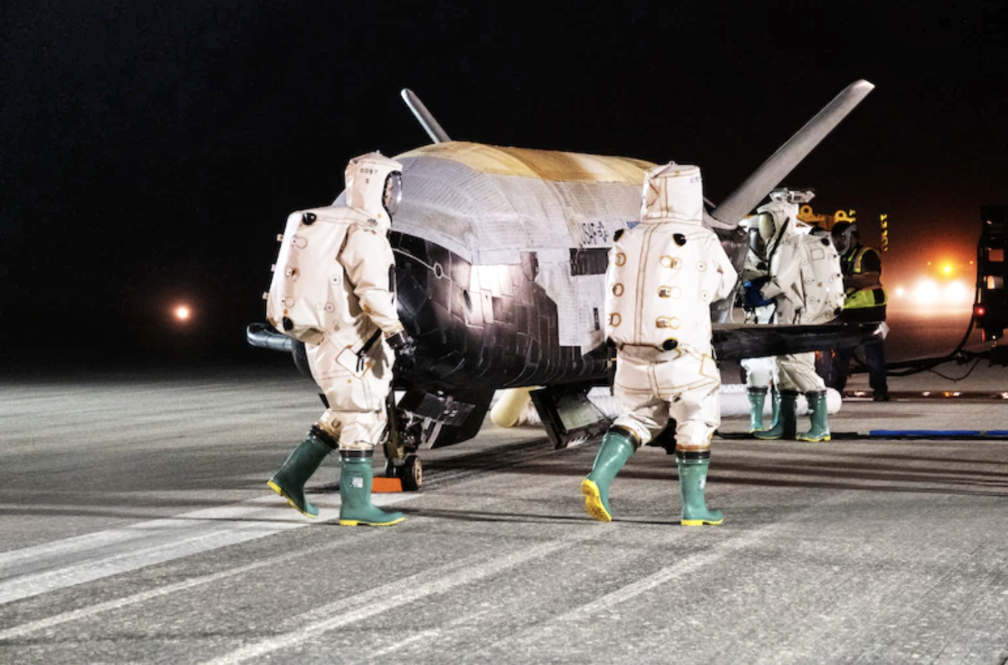
The U.S. Space Force’s unmanned, reusable spaceplane — the X-37B Orbital Test Vehicle-6 (OTV-6) — successfully de-orbited and landed at NASA’s Kennedy Space Center Shuttle Landing Facility after a successful deployment in space for 908 days.
OTV-6 was the first mission to introduce a service module-a ring attached to the rear of the vehicle expanding the number of experiments that can be hosted during a mission.
The service module successfully separated from the OTV before landing, which is a necessary activity due to the aerodynamic forces experienced by the X-37B vehicle upon re-entry. In the coming weeks, the service module will be disposed of in accordance with best practices.

The OTV-6 mission hosted the Naval Research Laboratory’s Photovoltaic Radiofrequency Antenna Module. This experiment successfully harnessed solar rays outside of Earth’s atmosphere and aimed to transmit power to the ground in the form of radio frequency microwave energy.

Multiple NASA experiments were deployed on OTV-6. The Materials Exposure and Technology Innovation in Space (METIS-2) included thermal control coatings, printed electronic materials, and candidate radiation shielding materials. METIS-1, which flew on OTV-5, consisted of similar sample plates mounted on the flight vehicle.
NASA scientists will leverage data collected after the materials have spent 900+ days in orbit and compare observed effects to ground simulations, validating and improving the precision of space environment models.
Another NASA experiment aims to investigate the effect of long-duration space exposure on seeds. Scientists are interested in the seeds’ resistance and susceptibility to space environment-unique stresses, notably radiation. The seeds experiment will inform space crop production for future interplanetary missions and the establishment of permanently inhabited bases in space.
“This mission highlights the Space Force’s focus on collaboration in space exploration and expanding low-cost access to space for our partners, within and outside of the Department of the Air Force (DAF),” said Gen. Chance Saltzman, Chief of Space Operations.
Secretary of the Air Force, Frank Kendall, said, “The deliberate manner in which we conduct on-orbit operations — to include the service module disposal — speaks to the United States’ commitment to safe and responsible space practices, particularly as the issue of growing orbital debris threatens to impact global space operations.”
“The X-37B continues to push the boundaries of experimentation, enabled by an elite government and industry team behind the scenes,” said Lt. Col. Joseph Fritschen, DAF Rapid Capabilities Office’s X-37B Program Director. “The ability to conduct on-orbit experiments and bring them home safely for in-depth analysis on the ground has proven valuable for the Department of the Air Force and scientific community. The addition of the service module on OTV-6 allowed us to host more experiments than ever before.”