

Rocket Lab USA, Inc. broke their annual launch record with the launch of “It Argos Up From Here,” a dedicated launch for General Atomics Electromagnetic Systems (GA-EMS). The mission was Rocket Lab’s 31st Electron launch overall and the eighth for the year to date, besting the company’s previous record of seven launches in 2020. Rocket Lab has now successfully launched a mission every month since April 2022, delivering frequent and reliable access to orbit.
“It Argos Up From Here” lifted off at 17:09 UTC, October 7, 2022 from Rocket Lab’s private orbital launch site, Launch Complex 1, on New Zealand’s Mahia Peninsula. The mission successfully deployed the GA-EMS-designed and manufactured GAzelle satellite carrying the Argos-4 Advanced Data Collection (A-DCS) payload.

The A-DCS mission is supported by NOAA’s Cooperative Data and Rescue Services Program, which arranged the launch through the Hosted Payload Solutions contract vehicle administered by the U.S. Space Force’s Space Systems Command.
Now in orbit, Argos-4 has joined a network of other Argos instruments to collect a variety of data from both stationary and mobile transmitters around the world. This vital information helps provide a better understanding of Earth’s physical and biological environment, including its weather and climate, biodiversity and ecosystems, as well as assist with maritime security, offshore pollution, and humanitarian assistance.
“Congratulations to the teams at General Atomics, NOAA, and France’s National Center for Space Studies on a successful mission,” said Rocket Lab founder and CEO, Peter Beck. “Beating our own annual launch record with such an important spacecraft delivering critical insights about our planet is a real privilege.”
Rocket Lab remains on track to continue its monthly launch cadence for the rest of the year, with missions scheduled from Launch Complex 1 in New Zealand, as well as the inaugural mission from Launch Complex 2 at the Mid-Atlantic Regional Spaceport on Virginia’s Eastern Shore.
General Atomics Electromagnetic Systems (GA-EMS) stated that the GAzelle satellite was successfully deployed into LEO and the establishment of communications is underway by GA-EMS mission control.
“We are extremely proud of the entire team, whose tremendous efforts culminated in today’s successful launch,” said Scott Forney, president of GA-EMS. “Once the satellite deployed, we began commissioning activities to establish the proper orbit, communications, and control of the GAzelle satellite and Argos-4 payload in preparation for the spacecraft to join the Argos constellation and begin its five-year mission. We are very excited to be a part of a program that is delivering critical data to scientists and researchers worldwide that will create a better understanding of Earth’s environment and wildlife, and how changes in our environment affect the world we live in.”
GA-EMS designed and manufactured the GAzelle satellite that carries the ARGOS-4 payload and the company performed all payload integration and testing prior to satellite launch. GA-EMS owns the GAzelle satellite and will manage satellite control and mission operations throughout the mission lifecycle.
“We congratulate our partners at NOAA, CNES, the U.S. Space Force, KSAT, and Rocket Lab as we launch the next generation of environmental monitoring technology into space,” said Gregg Burgess, vice president of Space Systems at GA-EMS. “This launch milestone places significant new capabilities into orbit to support a global data collection system dedicated to monitoring and protecting our planet’s environment and wildlife. We look forward to working on future opportunities to provide hosted payload satellites and mission operations for the collection and delivery of weather and environmental data and imagery for use by commercial and government customers worldwide.
General Atomics Electromagnetic Systems (GA-EMS) Group is a global leader in the research, design, and manufacture of first-of-a-kind electromagnetic and electric power generation systems. GA-EMS’ history of research, development, and technology innovation has led to an expanding portfolio of specialized products and integrated system solutions supporting aviation, space systems and satellites, missile defense, power and energy, and processing and monitoring applications for critical defense, industrial, and commercial customers worldwide.
Original posting…
The launch will take place from Pad B at Rocket Lab Launch Complex 1 on New Zealand’s Mahia Peninsula. The launch window opens 17:09 UTC on October 7th (06:09 NZDT, October 8th). Back-up opportunities are available in following days to accommodate potential weather delays to the launch.
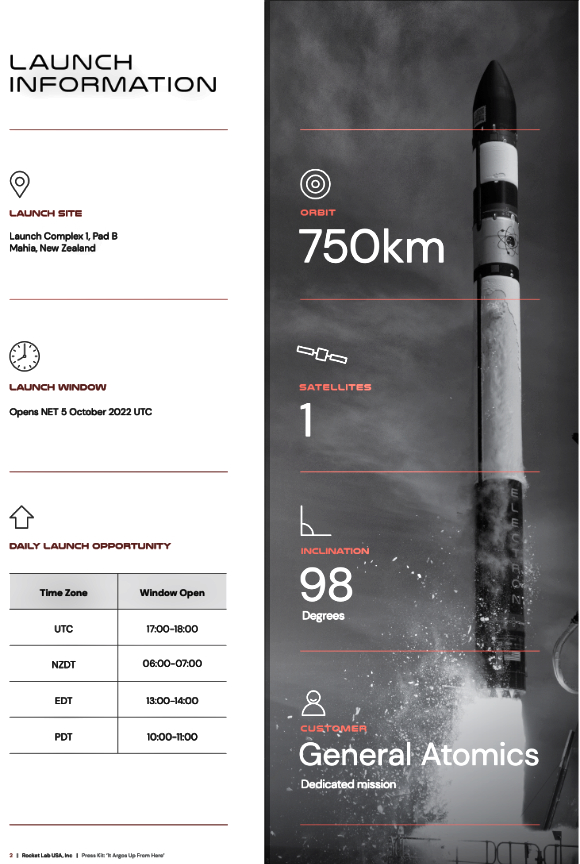

The “It Argos Up From Here” mission will launch the GA-EMS-designed and manufactured GAzelle satellite carrying the Argos-4 Advanced Data Collection (A-DCS) payload. The A-DCS mission is supported by NOAA Cooperative Data and Rescue Services Program, which arranged the launch through the Hosted Payload Solutions contract vehicle administered by the U.S. Space Force’s Space Systems Command.
Once in orbit, Argos-4 will join a network of other Argos instruments on-orbit to collect a variety of data from both stationary and mobile transmitters around the world. This vital information helps provide a better understanding of Earth’s physical and biological environment, including its weather and climate, biodiversity and ecosystems, as well as assist with maritime security, offshore pollution, and humanitarian assistance.
The launch will be broadcast live from approximately 20 minutes prior to lift-off at this direct link…
