
“The GHGSat microsatellites are able to detect and measure methane emissions from sources on the Earth’s surface that are 100 times smaller than those identified by other satellites.”
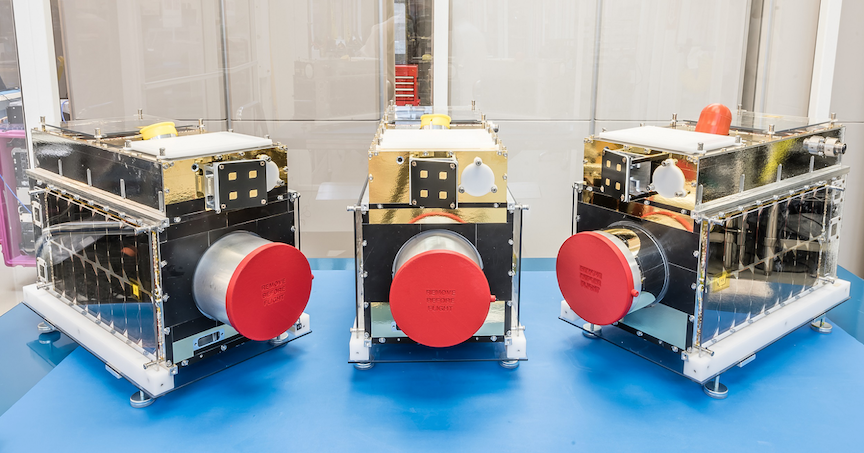
Space Flight Laboratory (SFL) and GHGSat Inc. announced the successful completion of laboratory testing on the GHGSat-C3, C4, and C5 microsatellites at SFL’s facility in Toronto. Canadian based company GHGSat is expanding its constellation of methane monitoring satellites, expected to launch in spring/summer 2022.
“SFL is proud to play a role in the important work GHGSat is doing to provide greenhouse gas monitoring as a commercial service,” said SFL Director Dr. Robert E. Zee. “The GHGSat microsatellites are able to detect and measure methane emissions from sources on the Earth’s surface that are 100 times smaller than those identified by other satellites.”
The three new GHGSat commercial high-resolution satellites will join the company’s current constellation already in orbit — GHGSat-D (Claire), GHGSat-C1 (Iris) and GHGSat-C2 (Hugo) — also built by SFL. Each microsatellite includes attitude control technology developed by SFL that enables the low-inertia platforms to point their onboard sensors precisely at emissions sources. All the GHGSat high-resolution satellites that have been, or are being, developed by SFL are built on the SFL 15-kilogram Next-generation Earth Monitoring and Observation (NEMO) microsatellite platform.
“We see emissions today. With a growing satellite constellation, GHGSat will be able to monitor even more methane emission sources around the world, offering more data and statistics on growing climate changes and trends. We have the data to make a difference,” says Stephane Germain, GHGSat CEO.

Testing of the GHGSat-C3, C4, and C5 satellites — named Luca, Penny, and Diako — began earlier this year following delivery of the methane-detecting sensors from ABB Measurement & Analytics Canada. SFL integrated the sensors into the NEMO buses and initiated a series of tests for each spacecraft and its subsystems, which included Long Form Functional Test, Electromagnetic Compatibility, Vibration, and Thermal Vacuum.
SFL also performed successful vibration testing of the XALT launch adapter which will mount the three microsatellites and their accompanying XPOD Delta deployer to a single 15-inch port on the launch vehicle. The XALT adapter and XPOD deployer are systems designed and developed by SFL to ensure the satellites separate safely from the launch vehicle.
“Throughout the testing, GHGSat-C3, C4, and C5 have met their design goals and are performing well above their baselines in all aspects,” said Dr. Benoit Larouche, SFL Mission Manager. “The satellites have been shipped to the launch site.”
SFL is a unique microspace provider that offers a complete suite of nano-, micro- and small satellites – including high-performance, low-cost cubesats which satisfy the needs of a broad range of mission types from 3 to 500 kilograms. Dating from 1998, SFL’s heritage includes 55 operational successes and 37 currently under construction or awaiting launch. These missions relate to Earth observation, atmospheric monitoring, ship tracking, communication, radio frequency (RF) geolocation, technology demonstration, space astronomy, solar physics, space plasma, and other scientific research.
In its 24-year history, SFL has developed cubesats, nanosatellites, and microsatellites that have achieved more than 186 cumulative years of operation in orbit. These microspace missions have included SFL’s trusted attitude control and, in some cases, formation-flying capabilities. Other core SFL-developed components include modular (scalable) power systems, onboard radios, flight computers, and control software.