
An agreement between NASA and the U.S. Space Force recently authorized the public release of decades of data collected by U.S. government sensors on fireball events (large bright meteors also known as bolides*) for the benefit of the scientific and planetary defense communities.

This action results from collaboration between NASA’s Planetary Defense Coordination Office (PDCO) and the U.S. Space Force to continue furthering our nation’s efforts in planetary defense, which include finding, tracking, characterizing, and cataloguing near-Earth objects (NEOs). The newly released data is comprised of information on the changing brightness of bolides as they pass through Earth’s atmosphere, called light curves, that could enhance the planetary defense community’s current ability to model the effects of impacts by larger asteroids that could one day pose a threat to Earth.
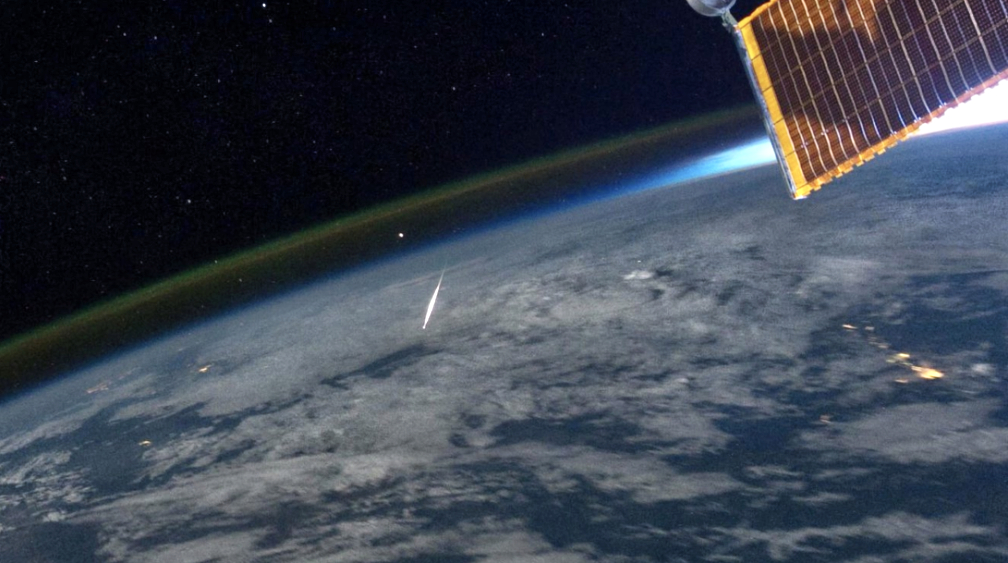
Bolides, very bright meteors that can even be seen in daylight, are a regular occurrence — on the order of several dozen times per year — that result when Earth is impacted by asteroids too small to reach the ground but large enough to explode upon impact with Earth’s atmosphere. U.S. government sensors detect these atmospheric impact events, and the bolide data is reported to the NASA Jet Propulsion Laboratory’s Center for Near Earth Object Studies (CNEOS) fireballs database, which contains data going back to 1988 for nearly 1,000 bolide events.

Now, planetary defense experts will have access to even more detailed data — specifically, light curve information that captures the optical intensity variation during the several seconds of an object’s breakup in the atmosphere. The data will be available to scientists as soon as it is properly archived, with the reported events and made easily accessible.
Credit: NASA
This uniquely rich data set has been greatly sought after by the scientific community as an object’s breakup in Earth’s atmosphere provides scientific insight into the object’s strength and composition based on what altitudes at which it breaks up and disintegrates. The approximate total radiated energy and pre-entry velocity vector (i.e., direction) can also be better derived from bolide light curve data.
“The growing archive of bolide reports, as posted on the NASA CNEOS Fireballs website, has significantly increased scientific knowledge and contributes to the White House approved National Near-Earth Object Preparedness Strategy and Action Plan,” said Lindley Johnson, planetary defense officer at NASA Headquarters. “The release of these new bolide data demonstrates another key area of collaboration between NASA and the U.S. Space Force and helps further the pursuit of improved capabilities for understanding these objects and our preparedness to respond to the impact hazard NEOs pose to Earth.”
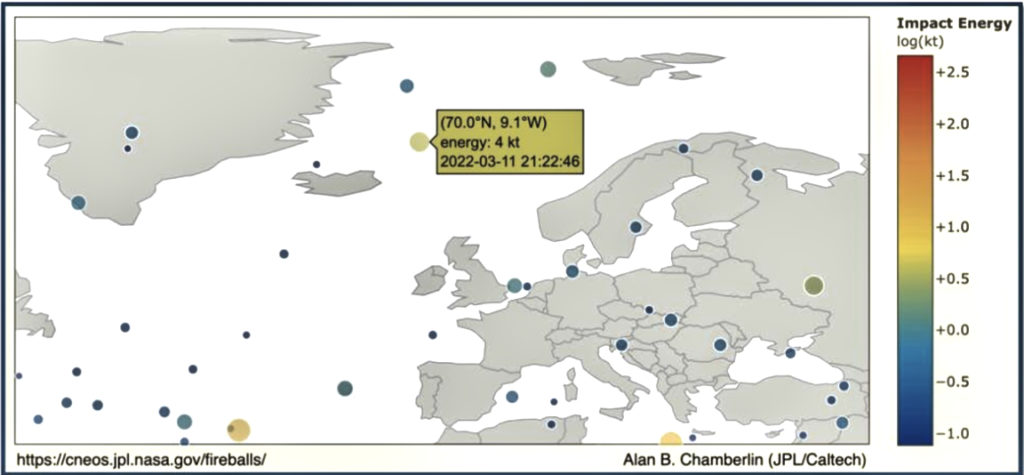
Recently a small asteroid approximately 2 meters in size, so small it posed no hazard to Earth, was detected in space as it approached Earth and impacted the atmosphere southwest of Jan Mayen, a Norwegian island nearly 300 miles (470 kilometers) off the east coast of Greenland and northeast of Iceland. While this asteroid, designated 2022 EB5, was much smaller than objects NASA is tasked to detect and warn about, CNEOS continued to update NASA’s PDCO with impact location predictions as observations were collected leading up to 2022 EB5’s impact, offering the planetary defense community a real-word scenario to test NEO tracking capabilities and give confidence that the impact prediction process and models are adequate for timely and accurate notification of the potential impact of a larger object, should one be discovered on a trajectory toward Earth. Similar to other bolide events, 2022 EB5’s impact was detected by U.S. Government sensors and reported by the U.S. Space Force units, confirming the time and location predicted by CNEOS, and added to NASA’s archive of these events at JPL CNEOS.
Credits: NASA JPL CNEOS and U.S. Space Force’s Space Operation’s Center.
Another notable bolide event in this released data set is of a meteor that was detected on January 8, 2014. This object gained the interest of the scientific community as it has been posited it could have interstellar origin due to the detected event’s high velocity within the atmosphere. Further analysis carried out under U.S. Space Command’s purview confirmed the object’s high velocity impact, but the short duration of collected data, less than five seconds, makes it difficult to definitively determine if the object’s origin was indeed interstellar.
NASA established the PDCO in 2016 to manage the agency’s ongoing efforts in planetary defense. NASA has been directed to discover 90% of NEOs larger than 140 meters (459 feet) in size. The agency is diligently working to achieve this directive and has currently found approximately 40% of near-Earth asteroids larger than that size.