
Combustors* are considered crucial pieces of gas engines and the chambers in which the combustion powering the engine occurs; however, combustors tend to break down as a result of deadly, high-frequency oscillations at the time of the combustion process.
Scientists from the Tokyo University of Science and Japan Aerospace Exploration Agency performed the latest time-series analyses based on complicated systems and unraveled the reason behind this breakdown, paving the way to resolve this issue.
Rocket engines include confined combustion systems that are typically combustion chambers. Nonlinear interactions in such chambers along with turbulent fuel and oxidizer flows, sound waves and heat generated from chemical reactions result in a volatile phenomenon known as “combustion oscillations.”
The force of such oscillations on the combustion chamber’s body—the mechanical stress produced on the chamber—is pretty high to cause the engine’s catastrophic failure. The question of what causes such oscillations is yet to be resolved.
A research team, including Professor Hiroshi Gotoda, Ms. Satomi Shima and Mr. Kosuke Nakamura, from Tokyo University of Science (TUS), together with Dr. Shingo Matsuyama and Dr. Yuya Ohmichi from the Japan Aerospace Exploration Agency (JAXA), has used the latest time-series analyses based on complicated systems to find the answer. This discovery was recently reported in the journal Physics of Fluids.
Hiroshi Gotoda, Professor, Tokyo University of Science, said, “Our main purpose was to reveal the physical mechanism behind the formation and sustenance of high-frequency combustion oscillations in a cylindrical combustor using sophisticated analytical methods inspired by symbolic dynamics and complex networks.”
The study outcomes have been reported by the Institute of Physics on their news platform Physics World and by the American Society of Physics in their news section.
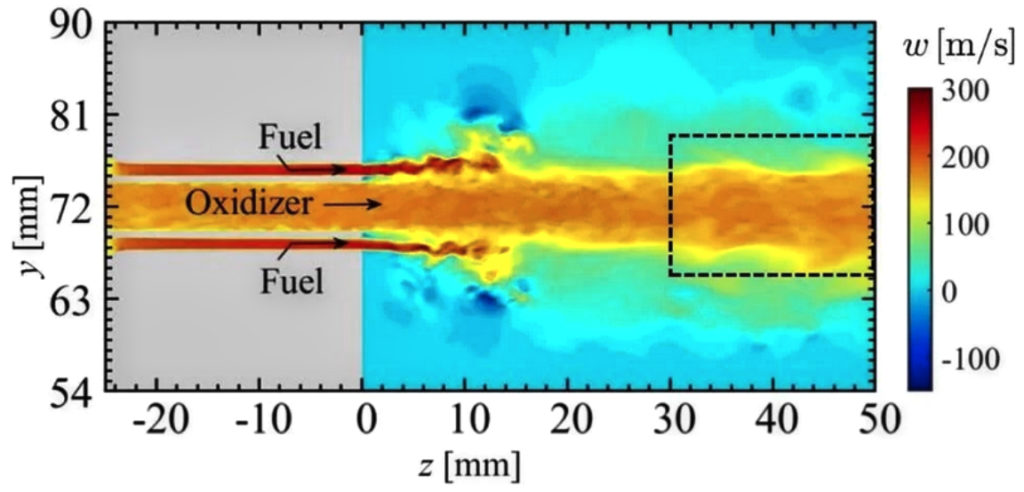
The combustor that was selected by the researchers to simulate is one of the model rocket engines. They could identify the moment of transition from the steady combustion state to combustion oscillations and imagine it. They discovered that the considerable, periodic flow, velocity fluctuations in fuel injectors tend to influence the ignition process, leading to alterations in the heat release rate. The variations in the heat release rate get synchronized with the pressure fluctuations within the combustor and the entire cycle progresses as a sequence of feedback loops that maintain combustion oscillations.
Moreover, by taking a spatial network of heat and pressure release rate fluctuations into account, the team identified that clusters of acoustic power sources periodically develop and fall in the shear layer of the combustor next to the rim of the injection pipe, furthering the combustion oscillations.
The study results offer logical answers as to why combustion oscillations take place, but specific to liquid rocket engines.
Hiroshi Gotoda added, “Combustion oscillations can cause fatal damage to combustors in rocket engines, aero engines and gas turbines for power generation. Therefore, understanding the formation mechanism of combustion oscillations is an important research subject. These results will greatly contribute to our understanding of the mechanism of combustion oscillations generated in liquid rocket engines.”
The results of the study are important and can be anticipated to pave the way for innovative routes of exploration to avoid combustion oscillations in crucial engines.
- A combustor is a component or area of a gas turbine, ramjet, or scramjet engine where combustion takes place.
Article repurposed from the AZO Materials infosite. Author: Laura Thomson
Journal Reference:
Shima, S., et al. (2021) Formation mechanism of high-frequency combustion oscillations in a model rocket engine combustor. Physics of Fluids. doi.org/10.1063/5.0048785.
Source: https://www.tus.ac.jp/en/