
• Skip to primary navigation
  • Skip to main content
  • Skip to primary sidebar
  • Skip to secondary sidebar
  • NEWS:
  • SatNews
  • SatMagazine
  • MilSatMagazine
  • SmallSat News
  • |     EVENTS:
  • SmallSat Symposium
  • Satellite Innovation
  • MilSat Symposium
  • SmallSat Europe

SatNews

  • LATEST
  • EXPLORE ⌄
    • Missions & Constellations
    • Business & Finance
    • Military & Defense
    • Launch
    • Software Automation & Ground Systems
    • Government & Regulation
    • Services & Applications
  • Magazines
  • Events
  • Calendar ⌄
    • IN PERSON
    • VIRTUAL
  • Subscribe

Northrop Grumman’s S.S. Katherine Johnson Leaves ISS To Begin Second Mission

July 6, 2021

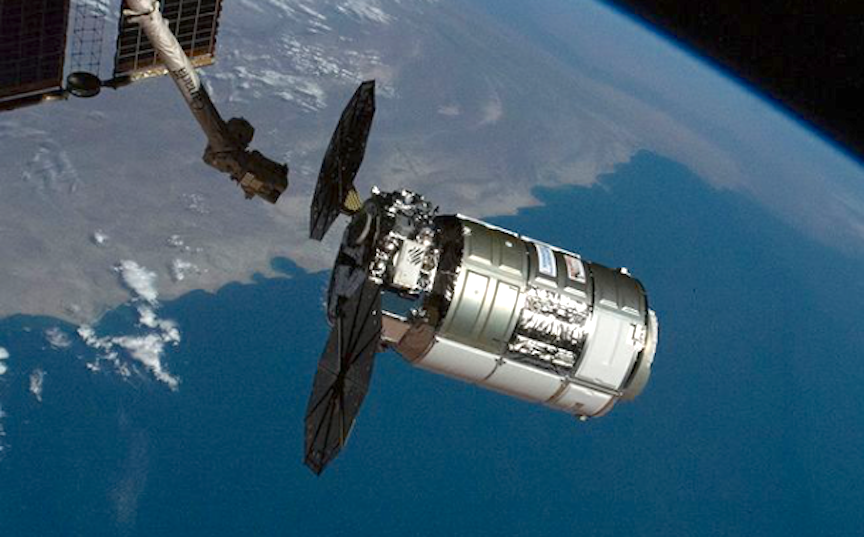
The S.S. Katherine Johnson begins the second phase of its mission after leaving the International Space Station (Photo: NASA)

Right on schedule Northrop Grumman Corporation’s (NYSE: NOC) Cygnus spacecraft left the International Space Station to begin the next phase of the NG-15 mission. Cygnus was released by the station’s robotic arm at 12:32 p.m. ET, carrying more than 8,000 pounds of disposable cargo where it will remain in orbit for approximately three days to carry out the secondary phase of the mission.

The S.S. Katherine Johnson will now deploy five CubeSats via two separate CubeSat deployers, Slingshot and Nanoracks. This Cubesat deployment includes Dhabisat, the second CubeSat developed by Khalifa University in Abu Dhabi, United Arab Emirates. Dhabisat was developed as part of Khalifa’s Space Systems and Technology Concentration, a joint program developed in collaboration with UAE-based satellite operator Al Yah Satellite Communications Company (Yahsat) and Northrop Grumman.

“Our Cygnus cargo resupply missions to the International Space Station help enable humans to live and work in space,” said Frank DeMauro, vice president and general manager, tactical space systems, Northrop Grumman. “With each mission, we grow our capabilities beyond cargo resupply as we operate a high performing science laboratory for both civil and commercial companies during the secondary phase of our flight.”

The NG-15 Cygnus spacecraft was launched on February 20 aboard Northrop Grumman’s Antares rocket, carrying nearly 8,000 pounds of scientific research, supplies and equipment to the astronauts living on the station. The vehicle has been berthed with the orbiting laboratory since February 22.

Filed Under: Exploration & Science Missions, Rocket Technology & Vehicles

Primary Sidebar

Coverage

  • Missions & Constellations
  • Business & Finance
  • Military & Defense
  • Launch
  • Software Automation & Ground Systems
  • Government & Regulation
  • Services & Applications

Most Read Stories

  • FCC Opens Review for SpaceX’s 15,000-Satellite VLEO Constellation
  • Congress desires LEO, but threats are real
  • USSF Awards Initial 'Golden Dome' Prototype Contracts, Signaling Strategic Shift to Space-Based Defense
  • Lawmakers Restore Funding for SDA Tranche 3, Add $1.2 Billion to Space Force R&D
  • SpaceX Targets $800 Billion Valuation in Secondary Sale, Eyes 2026 IPO

About Satnews

  • Contacts
  • History

Archives

Secondary Sidebar

We use cookies to ensure that we give you the best experience on our website. If you continue to use this site we will assume that you are happy with it.
x
Sign up Now (For Free)
Access daily or weekly satellite news updates covering all aspects of the commercial and military satellite industry.
Invalid email address
Notify Me Regarding ( At least one ):
We value your privacy and will not sell or share your email or other information with any other company. You may also unsubscribe at anytime.

Click Here to see our full privacy policy.
Thanks for subscribing!