

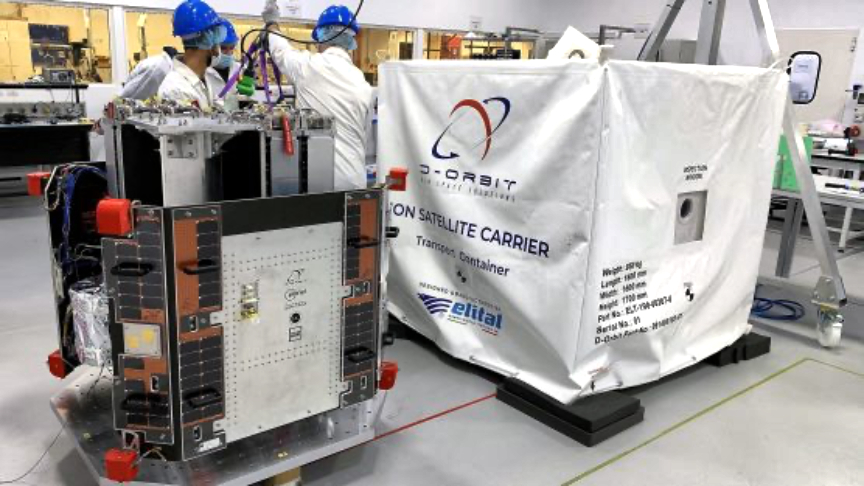
Dawn Aerospace has confirmed the company’s novel satellite thruster has been proven in space —six thrusters were onboard D-Orbit’s ION Satellite Carrier — the companies have been working together since early 2019.

Since launching on SpaceX’s Transporter-1 mission in January of 2021, D-Orbit’s ION space-tug for satellites has performed hundreds of in-space firings of each Dawn Aerospace B20 thruster.
This success is significant, due to the thruster’s use of alternative propellants to hydrazine, a fuel commonly used to propel satellites that is difficult to store and harmful to human health. Dawn’s B20 thruster achieves similar performance by using a unique, green-propellant combination; nitrous oxide and propylene. Having delivered this technology to both cubesats and smallsats, Dawn is demonstrating this technology can be applied to satellites of all sizes.
Thrusters, or in-space propulsion, are small rocket motors that form part of the satellite itself. They allow satellites to maneuver in space after their initial boost onto orbit. Thrusters serve several functions; they can perform corrective maneuvers if a satellite has been delivered to an incorrect orbit, they can orientate a satellite, can be used for collision avoidance, and can carry a satellite further afield, for example to a higher orbit or on a mission to the moon or another planet.
Using nontoxic propellants is naturally far less risky than using something such as hydrazine, which is toxic at extremely low concentrations – 40 parts per million. Dawn’s green propellants are great for the environment, but can also save the satellite operator about half a million (USD) per satellite by eliminating the safety precautions required to store and handle hydrazine. As Stefan Powell, the CTO of Dawn Aerospace, said, “That’s massive for small satellite companies for whom a total mission might only cost one million dollars or less. This in-orbit demonstration of our B20 product is the ultimate verification that our unique technology works. It is now possible to have the performance that satellite manufacturers loved about Hydrazine, with none of the environmental and cost drawbacks of using toxic fuels.”

On board SpaceX’s Transporter-1 mission were 133 commercial and government spacecraft (including cubesats, smallsats and orbital transfer vehicles) as well as 10 Starlink satellites – the most spacecraft ever deployed on a single mission.