
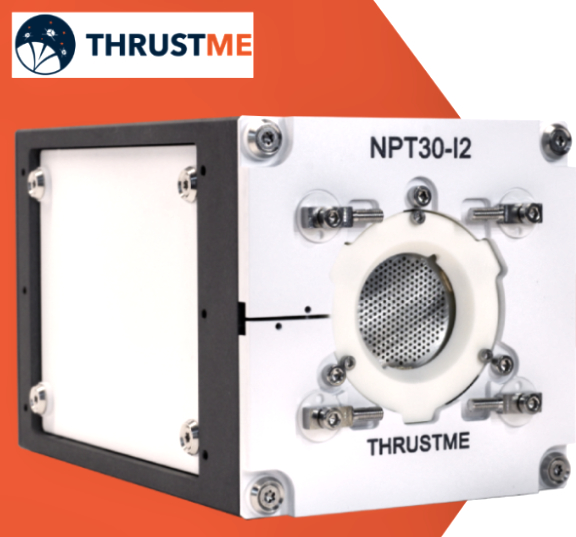
The Norwegian Space Agency and ThrustMe have announced they have completed trial integration of ThrustMe’s NPT30-I2 propulsion system into the NorSat- TD satellite.
During the mission, which is on schedule for launch in early 2022, both parties will demonstrate, amongst other things, just-in-time, low-thrust satellite collision avoidance maneuvers—a critical capability for acting on space situational awareness data and ensuring a sustainable space environment.

The NorSat-TD is the Norwegian Space Agency’s technology demonstrator mission that will lead the way to Norway’s maritime surveillance constellation. Onboard are six essential payloads and innovative technologies to be tested during the mission. One critical goal for the NorSat-TD project is to build up experience in Norway for propulsive satellite operations and ensure space safety by supporting the development of space situational awareness and traffic management systems for Norway’s upcoming future missions.
The iodine fueled NPT30-I2 propulsion system from ThrustMe was selected for its technical merits and relevance to the current and future Norwegian mission needs. Funding of the system was backed by the French space agency CNES, as an institutional partner to the mission. Additionally, the mission operations training and technical support provided by ThrustMe to the operators is fundamental to the mission objectives of building competence in Norway’s civil and industrial sector.
Fugro Norway is testing its sub-decimeter positioning payload, SpaceStar, on NorSat-TD. It will allow the Norwegian Space Agency and European Space Agency to follow the satellite’s position in Low-Earth-Orbit with very high accuracy; SpaceStar is sensitive enough to measure the thruster’s performance during transient propulsion periods for more accurate trajectory predictions. With SpaceStar and the onboard satellite laser ranging retro-reflector from SCF- Lab in Italy, the satellite provides multiple methods to track, predict, and verify its position. The ability to closely follow the satellite in real-time allows the operators to perform small safe test demonstration maneuvers, and test Space Situational Awareness (SSA) and Space Traffic Management (STM) architectures.
CNES will also support the evaluation of the thruster performances and precise navigation payloads with accurate ranging measurements done from Nice optical geodesy station.
“Norway is committed to safe and sustainable use of space, and the inclusion of ThrustMe’s propulsion technology is a concrete action to enable avoidance of collisions and reduce space debris at the end of the mission life,” said Christian Haugli-Hanssen, General Director of the Norwegian Space Agency.
“ThrustMe’s mission is to enable the growing space industry to remain sustainable while creating value on Earth and beyond. The NORSAT-TD mission will do exactly that. Getting the opportunity to assist the Norwegian Space Agency with our knowledge on how to prepare and operate a satellite with low thrust propulsion systems is extremely rewarding,” said Ane Aanesland, CEO and co-founder of ThrustMe.
“The NORSAT-TD satellite’s propulsion capacity thanks to ThrustMe’s iodine propulsion system, and the suite of precise navigation payloads onboard, gives the mission key capabilities needed to demonstrate the main CREAM* functionalities, which currently are under development in the ESA Space Safety Program,” said Tim Flohrer, head ESA’s Space Debris Office.