
The combined Landsat-9 Evolved Expendable Launch Vehicle Secondary Payload Adapter (ESPA) Flight System (EFS) team recently passed a major program milestone for NASA, known as Design Status Review 3.
After a detailed assessment between NASA and the mission partners addressing safety aspects for the range and a “Do No Harm” assessment to the anchor satellite vehicle, the Landsat-9 EFS completed its third and final design review on December 15 and was deemed ready to proceed to the final stages of integration.

The U.S. Space Force-developed EFS will fly with NASA’s Landsat-9 Earth observation satellite and carry up to 18 critical National Security Space and Civil multi-manifest satellite vehicles that will be deployed independently of the anchor satellite; maximizing the value of the launch. The MMO originally designed the EFS to fly only mass simulators as a proof of concept, but has advanced the mission profile to reflect the demand for on-orbit capability.
The joint effort is a NASA Goddard Spaceflight Center (GSFC) activity, funded and manifested by SMC’s MMO, located at Los Angeles Air Force Base in El Segundo, California.
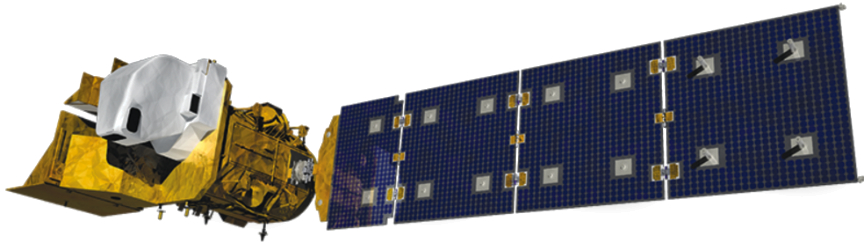
The next major milestone for the Landsat-9 EFS will be the integration and encapsulation of the Landsat-9 satellite vehicle. The NASA mission is scheduled to launch from Vandenberg Air Force Base in northern Santa Barbara County on United Launch Alliance’s Atlas V 401 launch vehicle in September 2021.
“The U.S. Space Force is using our Mission Manifest Office’s flexibility and efficiency to help our NASA partner make seamless manifest changes to a previously-planned mission,” said Colonel Robert Bongiovi, Director of the Space and Missile Systems Center’s Launch Enterprise. “This effort underscores MMO’s ability to understand its customer and mission partner’s programs and provide late-stage solutions for evolving capability needs.”
“Facilitating the ability to make flexible mission sets during the Landsat-9 launch campaign demonstrates one of many things the MMO excels at,” said Colonel Brad Walker, Chief of the National Security Space Launch Procurement Division at SMC. “The EFS highlights the Space Force’s commitment to innovative mission manifest solutions that deliver critical capabilities to support the warfighter and advance science and technology resources for NASA. Our partnership between NASA/GSFC and the USSF/MMO provides a unique opportunity to exercise both agencies’ strategic vision, creativity and individual skills.”

The Mission Manifest Office is part of SMC’s Launch Enterprise and is blazing a path for innovation in the space warfighting domain while continuing the SMC tradition of innovation in space. The MMO was established to provide a “one-stop” shop for the implementation of a routine, repeatable and reliable process for the multi-manifesting of U.S. Government and USG-sponsored payloads. The mission of the MMO is to utilize launch vehicle (LV) performance to maximize on-orbit capability. The MMO identifies DOD/Intelligence Community/Civil launch opportunities to enable and execute multi-mission manifesting mission design and late-stage additions and changes. The office provides agile and innovative solutions to increase launch opportunities for National Security Space (NSS) payloads in support of space warfighting construct and Launch Service Delivery Order objectives.