• Skip to primary navigation
  • Skip to main content
  • Skip to primary sidebar
  • Skip to secondary sidebar
  • NEWS:
  • SatNews
  • SatMagazine
  • MilSatMagazine
  • SmallSat News
  • |     EVENTS:
  • SmallSat Symposium
  • Satellite Innovation
  • MilSat Symposium
  • SmallSat Europe

SatNews

  • LATEST
  • EXPLORE ⌄
    • Missions & Constellations
    • Business & Finance
    • Military & Defense
    • Launch
    • Software Automation & Ground Systems
    • Government & Regulation
    • Services & Applications
  • Magazines
  • Events
  • Jobs
  • Calendar ⌄
    • IN PERSON
    • VIRTUAL
  • Subscribe

RUAG Space’s Satellite Computer is More than 250 Times More Powerful

December 1, 2020

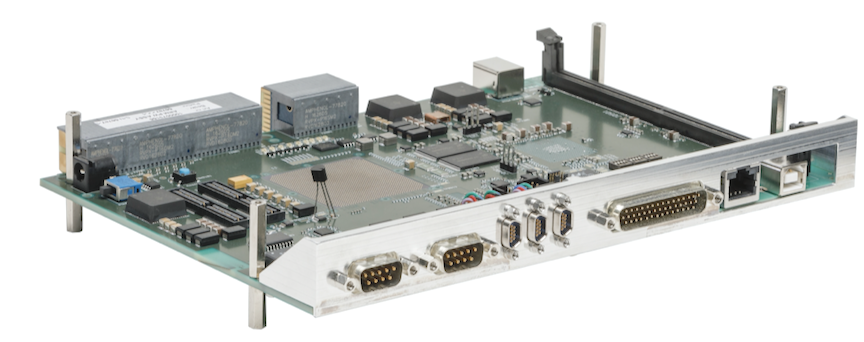
The Lynx Single Board Computer is designed for a long life in any satellite orbit (e.g. 15 years in geostationary Earth Orbit) or spacecraft trajectory. Copyright RUAG Space.

A new computer for satellites is more powerful than standard On Board Computers. RUAG Space‘s new Lynx computer is 250 times more powerful.

The development was achieved with the help of a contract from the European Space Agency’s program of Advanced Research in Telecommunications Systems (ARTES) and has been developed at RUAG Space in Gothenburg, Sweden. “Our computer contains an extreme amount of power,” explains Anders Linder, Senior Vice President Electronics at RUAG Space. Lynx is 250 times more powerful than the normal On Board Computers, which RUAG currently delivers to ESA programs.
“We have been very early with this development. This year, we are seeing that Artificial Intelligence and Machine Learning is starting to arrive in space development programs and now we have a computer ready that perfectly matches the requirements of these customers,” says Anders Linder. “Customers who want to do Machine Learning in space need a lot of computing power – which our computer can provide.” The Lynx On Board Computer will be qualified for space until end of 2021.

The Lynx Single Board Computer is designed for a long life in any satellite orbit (e.g. 15 years in geostationary Earth Orbit) or spacecraft trajectory. The computer offers a high-performance processor, which is provided by an ARM processor delivering 30000 DMIPS (short for Dhrystone MIPS, a computing benchmark). “That is a huge leap forward in processing performance for spaceborne computers,” adds Linder. A powerful FPGA (field-programmable gate array) offers flexibility in terms of communication, interface and processing capability. The computer can be used on the platform or in the payload. For its entire electronics portfolio RUAG Space offers a direct technical interface to U.S. clients in its office in Denver, Colorado.

Filed Under: Spacecraft & Payload Technology

Primary Sidebar

Coverage

  • Missions & Constellations
  • Business & Finance
  • Military & Defense
  • Launch
  • Software Automation & Ground Systems
  • Government & Regulation
  • Services & Applications

Most Read Stories

  • Russia ‘intercepts Europe's key satellites’ placing NATO satellite at risk
  • Germany boosts military space program with satellites and lasers
  • AT&T and Amazon Forge a Giant in the Skies: The Multi-Layered Strategy Behind the Kuiper-Cloud Pact
  • FCC Authorizes Logos Space to Deploy 3,960-Satellite Mega-Constellation for Enterprise Connectivity
  • Amazon Leo seeks 24-month extension from FCC due to launch shortages

About Satnews

  • Contacts
  • History

Archives

Secondary Sidebar

We use cookies to ensure that we give you the best experience on our website. If you continue to use this site we will assume that you are happy with it.
x
Sign up Now (For Free)
Access daily or weekly satellite news updates covering all aspects of the commercial and military satellite industry.
Invalid email address
Notify Me Regarding ( At least one ):
We value your privacy and will not sell or share your email or other information with any other company. You may also unsubscribe at anytime.

Click Here to see our full privacy policy.
Thanks for subscribing!