
• Skip to primary navigation
  • Skip to main content
  • Skip to primary sidebar
  • Skip to secondary sidebar
  • NEWS:
  • SatNews
  • SatMagazine
  • MilSatMagazine
  • SmallSat News
  • |     EVENTS:
  • SmallSat Symposium
  • Satellite Innovation
  • MilSat Symposium
  • SmallSat Europe

SatNews

  • LATEST
  • EXPLORE ⌄
    • Missions & Constellations
    • Business & Finance
    • Military & Defense
    • Launch
    • Software Automation & Ground Systems
    • Government & Regulation
    • Services & Applications
  • Magazines
  • Events
  • Jobs
  • Calendar ⌄
    • IN PERSON
    • VIRTUAL
  • Subscribe

SpaceX Launches Another 60 Starlink Satellites and Celebrates a Falcon’s 100th Flight

October 24, 2020

A launch delay on Thursday due to a small technical issue was corrected enabling today’s successful launch on Saturday, October 24, at 11:31 a.m. EDT, 11:31 UTC launch of SpaceX’s 60 Starlink satellites. The launch to orbit took place from Space Launch Complex 40 (SLC-40) at Cape Canaveral Air Force Station in Florida. The rocket launched at 11:31 a.m. during the instantaneous window, in which SpaceX did not have a longer timeframe to wait out possible weather violations. This mission also marked the 100th successful flight of a Falcon rocket since Falcon 1 first flew to orbit in 2008.
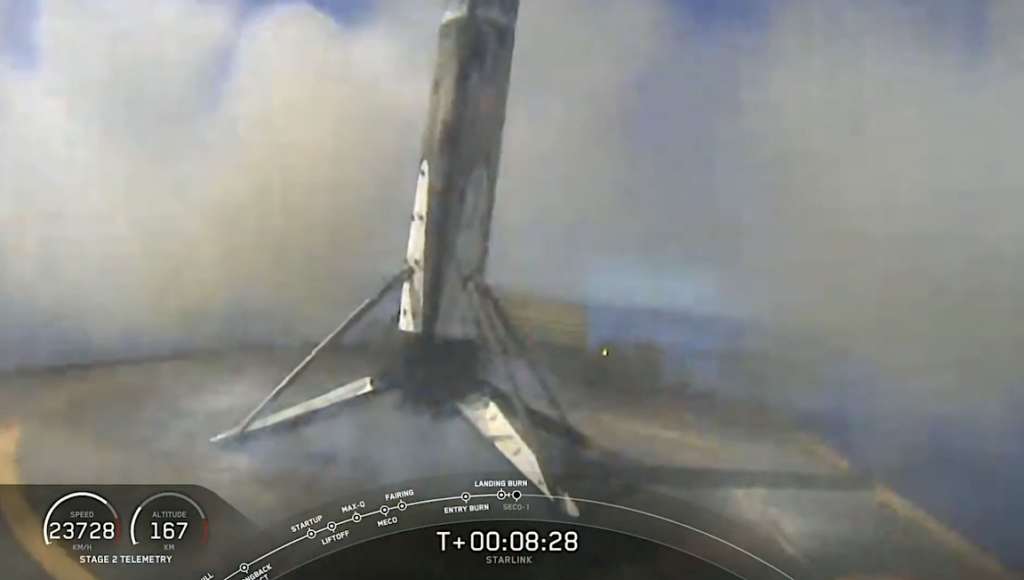
Falcon 9’s first stage previously supported the GPS III Space Vehicle 03 mission in June 2020 and a Starlink mission in September 2020. Following stage separation, SpaceX landed Falcon 9’s first stage on the “Just Read the Instructions” droneship, which was stationed in the Atlantic Ocean. The Starlink satellites deployed approximately 1 hour and 3 minutes after liftoff.

On Thursday, SpaceX CEO Elon Musk said in a tweet that the team reported “a small-seeming issue with loss of upper stage camera,” referring to the rocket’s second stage. “Probably nothing serious, but standing down to re-examine (the) whole vehicle just in case.”

Leading up to Saturday’s launch, SpaceX lead manufacturing engineer Jessica Anderson said the issue was resolved and the rocket was healthy.

SpaceX landed the booster about eight minutes after launch on the droneship called Just Read the Instruction already waiting in the Atlantic Ocean, marking the third flight for this rocket first-stage. SpaceX wasn’t attempting to catch the fairings for this launch but will retrieve them after they land in the water.

Filed Under: Launch, Satellite Communications

Primary Sidebar

Coverage

  • Missions & Constellations
  • Business & Finance
  • Military & Defense
  • Launch
  • Software Automation & Ground Systems
  • Government & Regulation
  • Services & Applications

Most Read Stories

  • Russia ‘intercepts Europe's key satellites’ placing NATO satellite at risk
  • AT&T and Amazon Forge a Giant in the Skies: The Multi-Layered Strategy Behind the Kuiper-Cloud Pact
  • FCC Authorizes Logos Space to Deploy 3,960-Satellite Mega-Constellation for Enterprise Connectivity
  • SES Executive Confirms End of the 15-Year Satellite Era
  • The Space Data Layer is Coming, Just Not as Fast or as Small as You Think

About Satnews

  • Contacts
  • History

Archives

Secondary Sidebar

We use cookies to ensure that we give you the best experience on our website. If you continue to use this site we will assume that you are happy with it.
x
Sign up Now (For Free)
Access daily or weekly satellite news updates covering all aspects of the commercial and military satellite industry.
Invalid email address
Notify Me Regarding ( At least one ):
We value your privacy and will not sell or share your email or other information with any other company. You may also unsubscribe at anytime.

Click Here to see our full privacy policy.
Thanks for subscribing!