
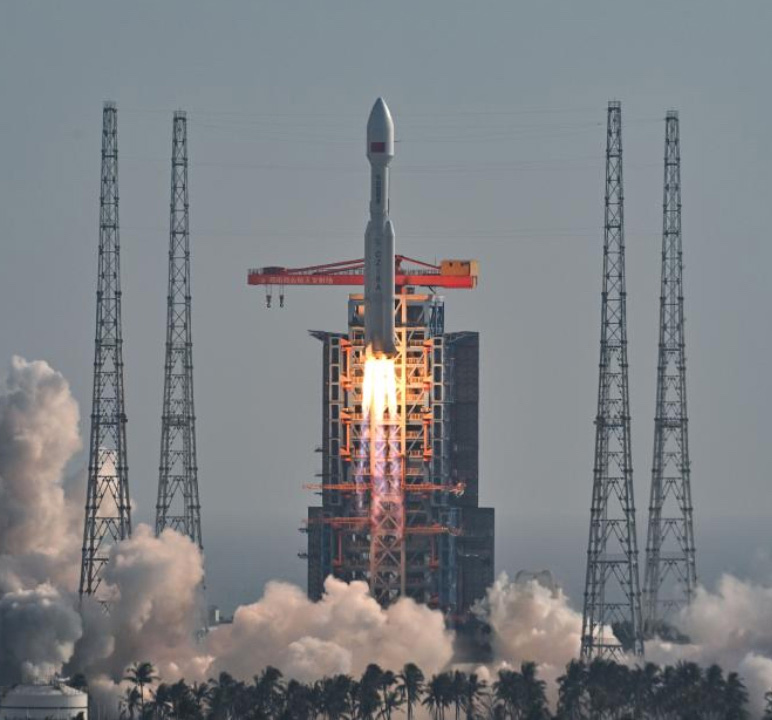
SatNews December 9, 2025 — Deploying assets ranging from the new Long March 8A to classified reconnaissance platforms, China has successfully executed four orbital missions in a span of 96 hours, a surge that underscores the nation’s accelerating launch cadence and expanding LEO infrastructure.
The sequence, which concluded early Tuesday, December 9, utilized four different spaceports—Hainan, Taiyuan, Jiuquan, and Xichang—demonstrating the China Aerospace Science and Technology Corporation (CASC)’s ability to coordinate simultaneous campaigns across its vast ground segment. This burst of activity comes as Beijing races to establish its national satellite internet infrastructure, known as Guowang (SatNet), and bolster its Yaogan remote sensing capabilities.
Strategic Shift to Commercial and High-Cadence Ports
The flurry of activity began on Saturday, December 6, with a milestone mission from the Wenchang Commercial Space Launch Site in Hainan. This marked the successful launch of the Long March 8A, an upgraded variant of the medium-lift vehicle designed specifically for commercial payload aggregation. The mission successfully deployed a group of internet satellites, signaling the operational maturity of China’s newest coastal spaceport, which is intended to relieve pressure on inland military bases.
Following the Hainan debut, operations shifted rapidly to the mainland. On Monday, December 8, a Long March 6A lifted off from the Taiyuan Satellite Launch Center. While the specific payload was not disclosed, the Long March 6A is the primary workhorse for the G60/Qianfan megaconstellation, suggesting this mission added capacity to China’s commercial LEO broadband network.
Hours later, the pace intensified with two launches occurring within a short window on December 9. A Long March 4B launched from Jiuquan carrying the Yaogan 47 remote sensing satellite, followed closely by a Long March 3B from Xichang deploying the TJSW-22 (Communication Technology Test Satellite) into a geostationary transfer orbit.
96-Hour Operational Manifest
| Date (UTC) | Launch Vehicle | Launch Site | Payload | Orbit | Mission Type |
| Dec 6 | Long March 8A | Hainan (Commercial) | Internet Sat Group | LEO | Mega Constellation |
| Dec 8 | Long March 6A | Taiyuan | Unknown (Likely G60) | SSO | Commercial/ Broadband |
| Dec 9 | Long March 4B | Jiuquan | Yaogan 47 | LEO | Military ISR |
| Dec 9 | Long March 3B | Xichang | TJSW-22 | GTO | GEO Comms/Test |
The Megaconstellation Imperative
This coordinated surge reflects a broader strategic imperative driven by CASC Chairman Wu Yansheng to secure orbital slots and frequencies before the window for LEO deployment narrows. The deployment of the Long March 8A is particularly significant; as a variant capable of carrying 7000 kg to LEO, it is tailored for the high-volume “bus” launches required to build out the 13,000-satellite Guowang constellation.
Simultaneously, the deployment of Yaogan 47 continues the expansion of the People’s Liberation Army’s space-based surveillance network. Western analysts typically categorize the Yaogan series as dual-use or military assets used for maritime monitoring and optical reconnaissance, critical for the PLA’s anti-access/area-denial (A2/AD) strategies.
2025 Launch Cadence Outlook
With these four successful missions, China is on track to exceed its 2024 record. The integration of commercial providers is also accelerating; CAS Space is preparing a Kinetica-1 solid rocket for launch from Jiuquan later this week, further augmenting the state-owned CASC manifest. The operationalization of the Hainan commercial pad suggests that 2025 will see a definitive shift toward coastal launches, allowing for larger payload fairings and reduced risk of falling debris over populated inland areas.