
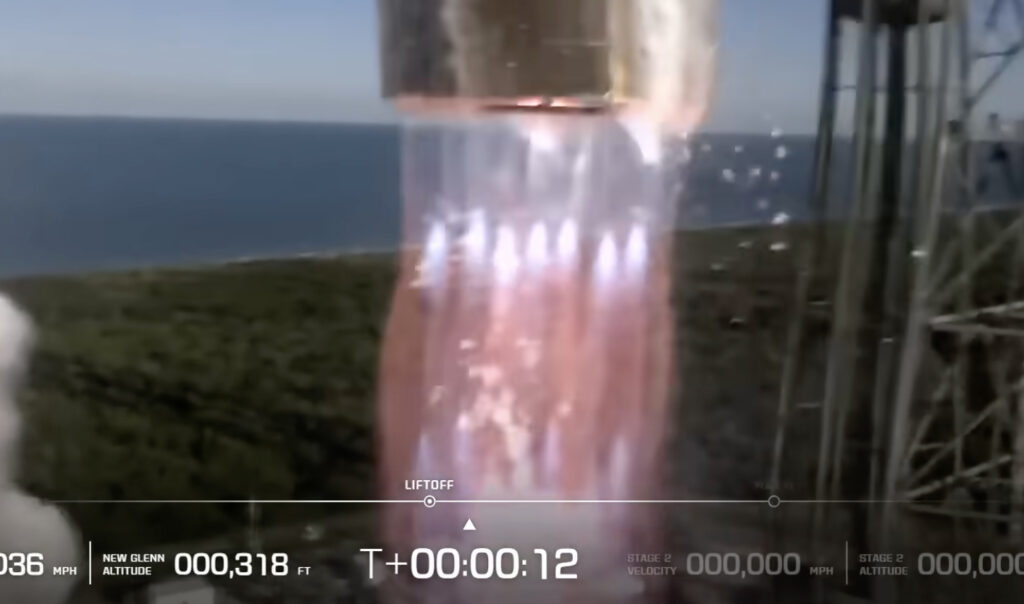
CAPE CANAVERAL, FL – Blue Origin has publicized their plans for a substantial “Block 2” variant. This action signals the company’s intent to rapidly increase payload performance in order to seize a larger share of the burgeoning launch market and to better compete in the highly contested Kuiper and National Security Space Launch (NSSL) Phase 3 bids.
The rapid iteration to a more capable “Block 2” addresses competitive pressures within the super heavy-lift sector, positioning New Glenn to rival the evolving mass-to-orbit economics presented by its competitors.
Enhanced Propulsion Systems Drive Performance Gains
Primary enhancements across the New Glenn platform include higher-performing engines on both stages. The total thrust for the seven BE-4 booster engines is increasing significantly from 3.9 million lbf (17,219 kN) to 4.5 million lbf (19,928 kN) (Following the first “lbf” I would indicate that the abbreviation stands for “pound force” – also, for “kN” note that is “Kilonewton”). This is achieved through advanced propellant subcooling and design refinements. The BE-4 engine has already demonstrated 625,000 lbf on the test stand at current propellant conditions and is slated to achieve 640,000 lbf later this year, a notable increase from the current operational thrust of 550,000 lbf.
The total thrust of the two BE-3Us powering New Glenn’s upper stage will also increase from the original design of 320,000 lbf (1,423 kN) to 400,000 lbf (1,779 kN) thrust, a transition planned over the next few missions. The BE-3U has already demonstrated 211,658 lbf on the test stand during validation testing.
Concurrent Upgrades and Operational Efficiencies
These propulsion enhancements will immediately benefit customers already manifested on New Glenn for a variety of destinations, including low-Earth orbit, lunar missions, and deep space exploration.
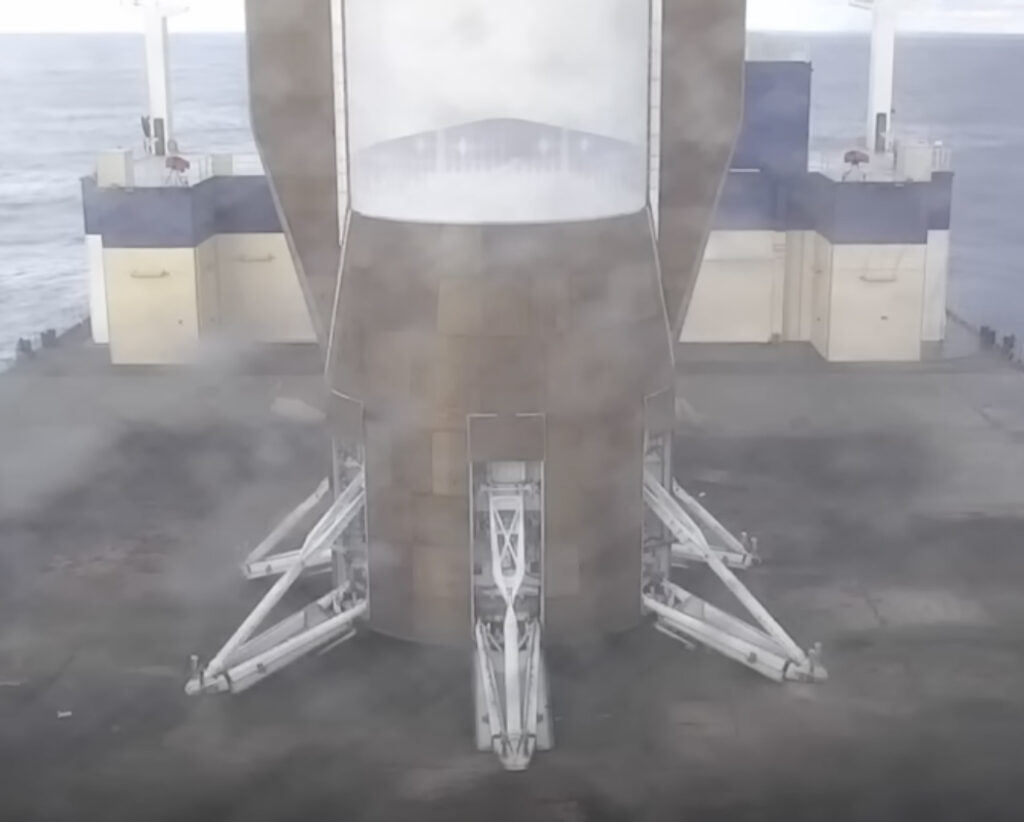
Additional vehicle upgrades focus on reusability and cost efficiency:
- A reusable fairing designed to support increased flight rates and lower turnaround times.
- An updated, lower-cost tank design methodology.
- A higher-performing, reusable thermal protection system.

New Glenn 9×4: The Super-Heavy Class Variant
The next chapter in New Glenn’s roadmap is the introduction of a new super-heavy class rocket variant, internally named New Glenn 9×4—named for the number of engines on each stage (nine BE-4s on the booster, four BE-3Us on the upper stage).
This 9×4 configuration is specifically designed for a subset of missions requiring substantial additional capacity and performance. The vehicle targets a payload capacity of over 70 metric tons to low-Earth orbit, over 14 metric tons direct to geosynchronous orbit, and over 20 metric tons to trans-lunar injection. Furthermore, the 9×4 vehicle will feature a significantly larger 8.7-meter fairing to accommodate bulkier payloads.
Both the enhanced current variant (7×2) and the new 9×4 super-heavy vehicle will serve the market concurrently, providing customers with more flexible launch options for critical missions such as mega-constellation deployments, lunar and deep space exploration initiatives, and national security imperatives like the Golden Dome program.
Images via Blue Origin