
Atomic-6, a leading manufacturer of advanced mobility composites, has introduced a revolutionary protection product for spacecraft and astronauts—Space Armor™ tiles.
Space Armor™ tiles are the first RF (radio frequency)-permeable orbital debris shield, resisting impact while allowing mission-critical radio communications to and from the satellite it’s protecting. In another world’s first, Space Armor™ tiles are fragmentation resistant – protecting spacecraft from debris without creating harmful secondary debris that endangers other satellites. With Space Armor™ tiles, available now for government and commercial satellites, Atomic-6 protects the future of human space activity and establishes a new standard for responsible space stewardship.
Satellites and astronauts are constantly threatened by millions of untrackable, hypervelocity particles in orbit. Such as a loose pebble hitting your windshield on the highway, orbital debris can strike at any time to do significant damage to spacecraft. Unlike the highway pebble, these debris travel at velocities of greater than 7 kilometers per second, nearly 16,000 miles per hour, making them explode violently on impact: penetrating fuel tanks, space suits, and tearing apart batteries and structures alike. With Space Armor™ tiles, spacecraft and the astronauts who fly them now have an unprecedented solution to protect against the increasing threat of space debris.
Though ballistic space “Whipple shields” have existed since the 1950’s, their traditionally metallic makeup is prohibitively heavy, blocks vital radio signals, and, when impacted, can often create more debris than it stops. Those very metallic layers that prevent penetration of unwanted orbital debris also prevent penetration of vital RF communications. For the first time in the world, Atomic-6 demonstrated Space Armor™ tiles that are both orbital debris shielding and RF-permeable, enabling hypervelocity impact protection for communications devices.
For decades, Whipple shields have been the industry standard “band-aid” for mitigating orbital debris impacts, but with one fatal flaw: their metallic faces fragment when hit. This fragmentation ejects harmful secondary debris back into space, which can go on to strike other satellites or astronauts at hypervelocity speeds. In this way, metallic shielding increases the debris population and risk of future collisions for everyone in orbit, exacerbating a phenomenon known as “The Kessler Syndrome.”
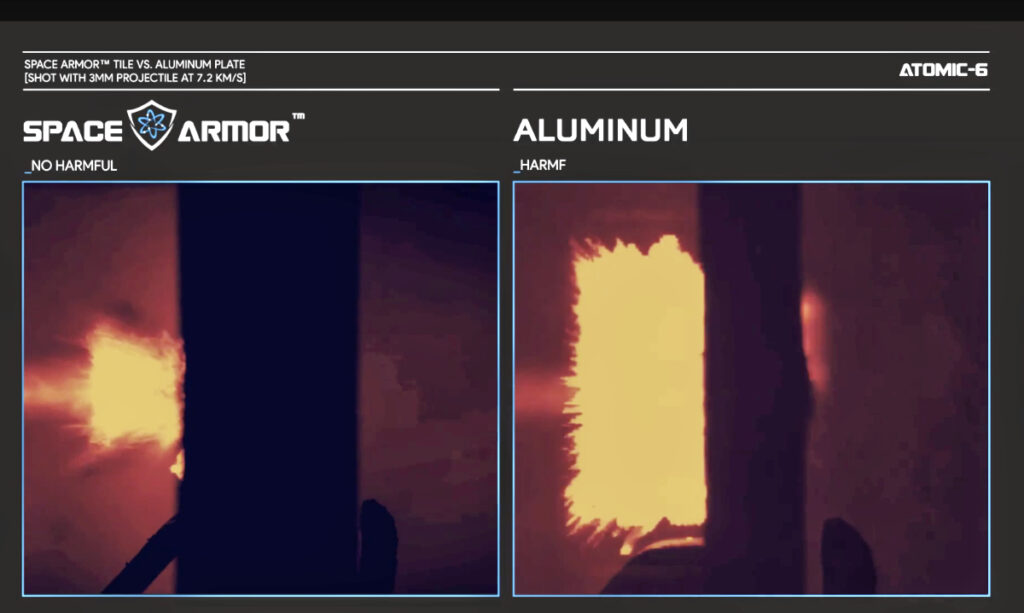
Atomic-6 Space Armor™ tiles are lighter and thinner than traditional Whipple shields, easy to install, and mitigates the creation of harmful debris. As seen in this side-by-side demonstration against aluminum, Space Armor™ tiles successfully stop a >7km/s projectile, producing virtually no byproducts. The aluminum equivalent shield, on the other hand, creates fragments larger than the initial projectile, and spalling debris behind the point of impact, which could damage the system it’s meant to protect.
Atomic-6 has developed two scalable protection levels in either RF-permeable or RF-blocking configurations:
- Space Armor™ Lite: Withstands debris impacts up to 3mm, which accounts for all untrackable debris and over 90% of all Low Earth Orbit (LEO) debris.
- Space Armor™ Max: Built for the most extreme conditions, it resists impacts up to 12.5mm, rated for human space station protection.
Both variants minimize shielding mass, stowage volume, post-impact ejecta, and overall mission risk—a critical advantage in both manned and unmanned missions. Space Armor tiles are now available.
This is a big deal. We made the first radomes that can stop orbital debris,” said Trevor Smith, CEO, Atomic-6. “You don’t have to sacrifice communications to protect your spacecraft anymore. This little composite tile preserves mission-critical functions, thereby protecting spacecraft, space stations, and people in orbit from increasingly prevalent, yet invisible threats.”